Tuesday, January 19, 2016

Red or brown sugar is better than white or refined sugar.


Dr Abe V Rotor 

Rural folks would rather eat panocha or muscovado, which is likened to whole grain with the bran intact (e.g. pinawa rice and whole wheat flour).  When sugar is refined, the very vitamins and minerals needed by our body’s metabolism are removed, going with the molasses which we usually use as feeds for animals. 

Sugar consumed in its natural state (like fruits and grains) are broken down and slowly released into the bloodstream, in a manner our body can program its assimilation.  But refined sugar raises the blood sugar rapidly.  This rush is followed by an equally rapid crash that often leaves us feeling tired, irritable or depressed.  As energy falls, our response is to reach for more sugar to perk us up.

The sudden rise and fall of our blood sugar causes emotional instability, confusion, dizziness, and headache.  Over-consumption of sugar can trigger a craving similar to the physiological dependence produced by drugs. These symptoms, along with drowsiness, forgetfulness, or general “spaced-out” feeling are typical symptoms of hypoglycemia (low blood sugar). Adrenaline is released during the body’s chemical chain reaction triggered by eating excess refined sugar, creating a stress throughout our body and mind. Sugar also depresses the activity of our white blood cells, lowering our resistance to infection. It may lead to the development of diabetes. For this reason many oriental nutritionists call refined sugar a “white poison.”


Kamote Tops Beauty


Dr Abe V Rotor
(Model: Miss Gelyn S Gabao, 19 Filipina)
Kamote (Ipomea batatas) tops contain more minerals and vitamins than any other vegetables, or its equivalent weight in meat and poultry. It is a glow food that enhances natural beauty and health, and gives that gait, poise and stride that many beauties display. It is the secret to acquiring and maintaining natural immunity and high resistance against diseases and other ailments. It contains substances that sharpen the brain and quicken responses to situations and the environment. 

It is a vegetable all year round. In summer kamote is grown in the fields and gardens for its enlarged roots or tubers which are rich in carbohydrates (go food) and rich in protein (grow food). In the habagat, it grows wild and luxuriant on hilltops, on levees and dikes, on the uplands, covering wide areas, keeping weeds down and protecting the soil from erosion. 

Kamote tops make an excellent dish with mungo and pork, bulanglang with shrimp or fish, and mushroom, or cooked in other recipes, or served as salad, blanched with red, ripe tomatoes and sliced onions, with a dash of salt, or a dip of fish sauce - bagoong or patis. Or cooked in tinola in place of pepper leaves, and green papaya. Why not blanch the tops on rice in its final stage of cooking? Add bagoong squeezed with calamansi or lemon. 

Kamote tops, maligned for being a poor man's food, rise to the apex of the food pyramid, top the list health programs, and doctors' prescription. Kamote tops occupies the rank of malunggay, alugbati, talinum, and spinach, relegating lettuce and other crucifers - cabbage and cauliflower and pechay - to the backseat.

Kamote tops are safe to health and the environment because they don't carry residues of pesticides applied on the field on many crops, and also those of toxic metals like lead, mercury and cadmium. Damaged parts are simply discarded, harvesting only the succulent and healthy leaves for further safety and better presentation.

Kamote tops come in green and purple, characteristic of the plant varieties, but in both cases, the same nutritive values are derived, with some advantage from the purple variety which contains xanthophyll in addition to chlorophyl. Both are recommended for anemic persons for their high iron content, and to those suffering from poor bone development, poor eyesight, and poor metabolism.

Beauties come naturally with good food, simple and active lifestyle, in the rural areas where sunshine, clean air and surrounding, make a perfect combination from which spring the true beauty of man and woman, as compared to the makeup beauty from cosmetics, expensive salons, and by the so-called wonders of science and technology like liposuction and surgery. Why can't we simply eat kamote tops more often?~

Queer Looking Trees from Another World


Photos and Poem by Dr Abe V Rotor
 Bearded Eucalyptus Tree, Angels' Hill, Tagaytay City. Clinging moss 
is actually lichens of the fruiticose or hanging type.

I love trees friendly or queer,
they whistle with the breeze;
they sigh in summer air, 
and make me feel at ease.

I love trees real or fancy,
tall, small, and spreading;
lining the shore, or foothill,
atop a mountain like king.

I love trees in all seasons,
even with their grotesque crown;
buds in spring fullest in summer;
and in autumn red and brown. 

I love trees, their make-believe faces,
dare to imagine in the evening, 
the legendary white lady;
or beauteous Maria Makiling.  

I love trees they are like people,
senses, language of their own
are universal to all creatures,
even before man was born.  

I love trees because I see myself
in them today as it was before;
and if i think trees are really queer,
I think I should love them more. ~

Balete (Ficus benjamina) strangles own host (acacia - 
Samanea saman), hence called Strangler's Fig, UST Manila

Ghost singers under a huge banyan tree, Sacred Heart Novitiate, QC 
(Photo taken after a wedding reception, unedited photo.) 
Ichabod Crane Tree, SPUQC (Fiction character in a 
short story  of the same title by Washington Irving)
Who is knocking on my window sill? (kalachuchi - 
Plumera acuminata), Sacred Heart Novitiate, QC
Tree casts its own shadow of death before its early 
demise following Ondoy flood in 2010 , UST Manila
Python Tree, an overhanging limb of acacia covered
 with epiphytes, Ateneo de Manila University, QC
Haunting Fig Tree (Gmelina), Church of the Ascension Parish Church, 
Lagro QC. Its broad prop roots produce a dull gong sound when struck.  


Leaning Pisa tree (Fire tree - Delonix regia) leans 45 degrees 
over busy Regalado Avenue, QC. NOTE: the tree was cut down 
to clear power lines, and eliminate possible accident. 
 
Elephant Tree, Kaohsiung, Taiwan

Monday, January 11, 2016

Flow gently, sweet little stream

Painting and poem by Abe V Rotor

                                                Flow gently, sweet little stream in acrylic (2' x 4') by AVR 2012
Flow gently, sweet little stream,
     and I will sing you a praise;
Flow gently down the little valley,
     and I will go with your ease.

Flow gently sweet little stream,
     for you have time to tarry;
Flow gently around rocks and hills,
     meander and be merry.

Flow gently, sweet little stream,
     and do not grow up too soon;
Flow gently with the watershed,
     catching the rains in monsoon.

Flow gently, sweet little stream,
     living link of sky and sea;
Flow gently among the creatures
     in your care, play and be free. 

Flow gently, sweet little stream,
     away from the hands of men;
Flow gently in this hidden den,
     this lovely patch of Eden. ~

"Bring home the rainbow, Papa."


Dr Abe V Rotor
Kulit plays with the rainbow at home.
A piece of rainbow spills on the floor like magic carpet.
Prism splits light into seven colors - the rainbow's secret.

I am no Atlas or Hercules,
neither have one another's wit,
nor Thor who sends the rain
or a storm in his fit.

To bring home the rainbow
for my children's sake,
by lens or words to escape,
would be sin if I fake.

Once I brought home a firefly.
Here is a a star, I said;
and through the night it watched
over them in their bed.

Once I brought home the sun
in a bouquet of sunflower;
And the moon in yellow melon,
the sea, in a queer puffer.

Bring home the rainbow, Papa.
That was a long time ago,
a promise I have not fulfilled -
what now at sunset's glow? 

Suddenly the sun came through
a prism by its magic drew
a cathedral in the sky I knew.
Papa, you brought home the rainbow!

 Rainbow over Bamban, Tarlac
 Fantasy rainbow in cartoons and fairy stories
A double rainbow, not an unusual phenomenon

Sunday, January 10, 2016

Experimental Painting - Aimless Expression?


Paintings by Dr Abe V Rotor


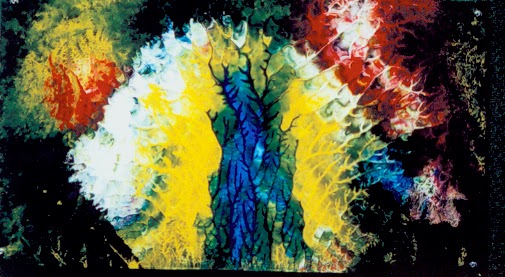
Stained glass effect - result of two paint mediums that are not miscible, one oil- and the other water-based.   

Immiscible as acrylic and oil, two mediums used;
yet by the magic of art they stood up and fused;
conflict - antithesis of unity- yet builds in duality
the essence of beauty through contrast in harmony;
for whatever purpose the artist portrays his theme,
by plan or serendipity, or aimless as it may seem.

Monday, January 4, 2016

Revival of FINE ARTS, with Nature as Theme


Fine Arts reached its peak in the ancient world with "the glory that was Greece" and "the grandeur that was Rome." As a movement, it underwent a stormy history. How can it weather the present environmental upheaval, and become a agent of reform?

Dr Abe V Rotor 

  • Fine arts reached its peak with "the glory that was Greece" and flourished in the "grandeur that was Rome." This was in the known world then, the Greco-Roman Empire which lasted for a millennium.
  • Then the world plunged into the "Dark Ages."Whatever happened to mankind remained in limbo for more than five hundred years. Black Death decimated Europe's population by one-third. Religious conflicts gave rise to fanaticism and ruthlessness, with victims surpassing the number of those killed in the two world wars combined. The sense of nationhood was far fetched, more so of a united world. What with the warring fiefs and kingdoms?

  • Then in the fifteenth century dawned the Age of Renaissance which adopted the Greco-Roman model and the rise of Christianity shifting from mythological themes. Many of the great works depicted renewal of faith in God such as the works of Michelangelo, Da Vinci, Raphael, and later Shakespeare in literature. The later part of the Renaissance saw the rise of science (Galileo), exploration (Columbus), and politics (Machiavelli).  
  • The Renaissance followed on the heels of the Middle Ages, and was spawned by the birth of the philosophy of humanism, which emphasized the importance of individual achievement in a wide range of fields. The early humanists, such as writer Francesco Petrarch, studied the works of the ancient Greeks and Romans for inspiration and ideology, mixing the philosophies of Plato and other ancient thinkers with the teachings of the Roman Catholic Church. Under the influence of the humanists, literature and the arts climbed to new levels of importance.
  • The environmental movement has its roots in the 19th century with American Philosopher Henry David Thoreau (Walden Pond), John Muir (creation of Yosemite National Park). As industrialization grew the preservation of  the environment became the leading movement in the early twentieth century, becoming the basis of modern environmental movement which began in the mid-to-late 1960s. Rachel Carson (Silent Spring ).  "Modern" art became associated with the Hippie movement and Counterculture, post-impressionism, surrealism, among other recent schools of abstract art. Towards the end of the 20th century the need for green technology was realized - now the subject on world summits, the latest being that of the 2015 Paris Summit on Global Warming. The conservative Roman Catholic Church led by Pope Francis issued an encyclical letter Laudato Si - a universal call for universal brotherhood  in saving Mother Earth.
. ------------------------------------------------------- Author's Note:  Five students taking up Fine Arts as a course at the University of Santo Tomas visited me for an interview at home in Lagro, QC.  It is at home where I could show my works as a nature-artist, principally a 90 feet long by 7 feet (average) tall wall mural which I painted around the periphery of my residence. (As shown in the photographs below.)   

For quite a time I pondered on the real theme of the interview. I maybe bias to the scientific aspect of nature which is closely associated with ecology, in which case art would be subservient to equations and formula, defining in colors and lines such terms as dynamic balance and biological diversity. On the other hand, if emphasis is on the side of art,  the tendency of art is to sacrifice ecology if favor of subjective interpretations. 

Indeed, the occasion opened to mind a relatively recent movement - eco-art - a contraction of art depicting nature.  It is broad and general though.  But it is this vastness that many will agree with me in proposing The theme, Return to Fine Arts with Nature.
   
Applying the ancient world of fine art, not only on to the perfection of art for art sake, but on Mother Nature as subject, maybe what we need to create a movement with two objectives: revival of the fine art which has dovetailed into various abstract forms; and the elevation of awareness of Nature's beauty and significance in our present campaign to preserve the environment. 

I would like to invite our pageviewers, readers, and radio listeners on Paaralang Bayan sa Himpapawid to tune in simultaneously with viewing this blog, Living with Nature.  I also invite them to search and red the related articles in this Blog, albeit other references, to enrich our consciousness on the unity and harmony of Fine Arts and Nature.   
---------------------------------------------- 

Giant heart-shape frame for Mother Orangutan and Child , a gamely triangulation, exudes joy and exuberance to these city-bred ladies. Deep in our mind is the universal instinct of motherhood which challenges man's rationality and values.  To what extent is primal instinct genetically ingrained and spread in the living world?  To what advantage (or otherwise) has this relationship evolved in guaranteeing the survival of species.  Through fine arts, reach out for the wondering mind.

The biggest animal creature that ever lived - the blue whale, larger than any of the dinosaurs - brings down-to-earth knowledge and understanding about this enigmatic creature. Why it has survived through millions of years, how it became adapted to ocean life when its ancestors were originally land dwellers, how it keeps its huge body warm as a mammal in the cold seas - are not just imagination and fantasy, but real.      

Photo, left to Right: Ben Matthew Gueco, Jose Paulo Lorenzo P Geronimo, Maria Cristelle Aubrey Ganson, Vanessa Jadianne Yao and Kristine Danica Lim, all from the UST College of Fine Arts and Design (CFAD)  


Meditation with Nature by the seaside, at the inter tidal zone with rare creatures, where peace and solace reign. It is not any lesser to religious meditation. In fact, it is an experience real and true with all our senses, psyche and spirit notwithstanding.
Art takes us closer to nature, it defines our role, humbles us, makes us realize that Paradise is not forever lost, and that it is only in heaven that true joy is found. Nature offers us so many opportunities to rebuild that lost Garden by our own hands in whatever capacity - even just to discover a flowering weed and make others share this experience for a moment.


Knock, knock! The door closes after us, as Nature opens.  When we leave our home  we open the gate to meet Nature.  She's just a step away.  In fact she is with and in us.
The air we breathe, water and food we take, things we wear, light to see her wonders, creatures around us, ad infinitum.  How do we greet Nature in the morning? Bid goodbye at the end of the day, say our Thanksgiving? Express the fine art of awareness in painting, music, literature, and other creative ways. 


Sun in the depth of the sea - an illusion? Is the deep beyond the lighted zone a world of darkness.  To us humans our senses are designed for terrestrial life, we cannot perceive what the bottom dwellers can. What is human superiority, what is scientific breakthrough? Humility rises where and when we submit ourselves to the mystery of creation, and cease to question, to doubt. Fine arts is submission to such humility.


Talk to the hornbill (kalaw).  Ask where it has been for so long a time.  Is he and his mate survivors of a biological upheaval?  Has this bird lost its own species, that it is no longer a part of a population but just an endangered flock? There is a song, Where have all the flowers gone? - allegorically applicable to other living things. How can this  explain the cause of extinction of species. Fine arts may yet save today's threatened and endangered species.     
 

Nature holds the key to our aesthetic, intellectual, cognitive and even spiritual satisfaction.
- E. O. Wilson