Monday, December 15, 2014

Christmas Stories, Events, Jokes & Quotes

Christmas Stories, Events, Jokes & Quotes
Selected and compiled by Dr Abe V Rotor
Living with Nature School on Blog
Paaralang Bayan sa Himpapawid (People's School-on-Air) with Ms Melly C Tenorio
738 DZRB AM Band, 8 to 9 evening class Monday to Friday


 The small girl had spent the morning watching her mother do her Christmas shopping.  Finally, she found herself in a big chair beside the department-store Santa Claus, tell him her wishes.  "... and a big doll and a doll buggy and a doll house ..."  she finished the long list.  Then sliding from the chair and walking away, she suddenly turned back a pace, and called, "And charge it, Santa Claus!"
x x x x
CONDUCTOR: "You know darn well the distance between Chicago and Cleveland is the same as from Cleveland to Chicago. Any damn foo knows that."

PASSENGER: "I dunno; it is just a week from Christmas to New Year, but is it a week from New Year the Christmas?" 
x x x x 
A youngster walked into a bank the other day to open an account with $1000.  The bank's vice president gave him a benign smile and asked how he had accumulated so much money.

"Selling Christmas card," said the lad.

"Well, you've done very well.  Sold them to lots of people, obviously."

"Nope," answered the little boy proudly.  "I sold all of them to one large family - their dog bit me."
x x x x
A mother took her five year old son to a mall to say, "Hello" to Santa Claus, who in turn, asked. "What would you like for Christmas, sonny?" 

"A bicycle, a football, and a pair of skates." the youngster replied promptly.

"I'll certainly try to see that you get them," said Santa. 

Later, the mother and son visited another mall and stopped to see Santa there.  Again the same question and the same answer, but Santa asked, "And are you going to be a good boy?"
x x x x

A little girl about five received a box of crayons for Christmas and made a great many pictures.

"What is this one?" her mother asked.

"That's  Baby Jesus on the manger."

A little to one side were three vertical lines - the wise men perhaps, or the shepherds.  The mother inquired what they were.

"Mary and Joseph are going out for the night." the child explained, "and that's the sitters coming in."  

x x x x
Here it is the middle of January and we're still cleaning up from Christmas.  Last week we cleaned out our checking account; this week we cleaned out our savings account. 

x x x x

What do you call a kid who doesn't believe in Santa? A rebel without a Claus.
What is the popular Christmas carol in Desert? Camel ye Faithful.
What part of the body do you only see during Christmas? Mistletoe.
What do you call people who are afraid of Santa Claus? Claustrophobic.

 x x x x
If you want to be reminded of Christmas all year, buy your Christmas gifts on monthly payment plan. 

x x x x 
May the forgiving spirit of Him to whom we dedicate this season prevail again on earth.

May hateful persecution and wanton aggression cease.

May man live in freedom and security, worshiping as he sees fit, loving his fellow man.

May peace, everlasting peace, reign supreme.

Unusual Historical Events That Happened During Christmas

  1. Christmas Day, 1990, The Internet Gets Its First Test Run
  2. Washington Crosses the Delaware River in 1776
  3. WWI Christmas Truce Soccer Games
  4. USSR Invades Afghanistan in 1979
  5. Isaac Newton Was Born on Christmas Day
  6. Charlie Chaplin Passes Away
  7. Apollo 8 Reaches the Moon’s Orbit
  8. Mikhail Gorbachev Resigns as Soviet President
  9. The Song ‘Silent Night’ Is First Performed in Public
  10. President Andrew Johnson Pardons All Confederate Soldiers
  11. Charlemagne Crowned Holy Roman Emperor, year 800.
  12. William the Conqueror Crowned King of England, 1066
  13. World War I Soldiers Hold Christmas Truce 1914
  14. Andrew Johnson Pardons All Confederate Soldiers, 1868
  15. Hirohito Becomes Emperor of Japan, 1926
  16. President Nicolae and Elena Ceausescu of Romania Executed, 1989 
  17. Ford Model T Unveiled, 1913
  18. John Adams and Thomas Jefferson, former presidents of the US, Die, 1826 
  19. A 2004 earthquake in south-east Asia, measuring 9.3 on the Richter scale, led to a devastating group of tsunamis the next day, which would ultimately kill over 200,000 people. 
  20. Christmas day is also the birthday of (among many other notables) cosmetics tycoon Helena Rubenstein, Egypitian president Anwar Sadat, and Mohammad Ali Jinnah, the founder of Pakistan. and several entertainers. . 
References" JM Braude, Speaker's Encyclopedia of Humor; Prochnow HY and HV Prochnow Jr, Jokes, Quotes and One-liners for Public Speakers; Wikipedia; Internet

Word Riddle about Christmas and Santa Claus  

1. Where does Santa put his suit after Christmas? CLAUset

2. Why did Santa get a ticket on Christmas Eve? He left his sled in a Snow Parking Zone

3. Why was the manger so crowded on Christmas Eve? Because of the Three Wide Men
4. What song do socks sing while they hang by the fireplace? Silent Night HOLEY Night

5. A Christmas tree that has a big nose is called what? Pine-occhio

6. What do vegetarians wish for at Christmas? Peas on earth and goodwill toward men

7. How did Santa get lost on Christmas Eve? Because he got miSLED

8. Who's worth about 5 cents at Christmas? Old St Nickel (Nicole)

9. What happened when Santa parked his sled illegally? He was mistle-TOED

10. Why does Father Christmas cry a lot? Because he got santa-mental


Friday, December 12, 2014

Twelve Reasons I Love Philippine Literature

Dr Abe V Rotor 
Living with Nature School on Blog 
Paaralang Bayan sa Himpapawid with Ms Melly C Tenorio 
738 DZRB AM, evening class 8 to 9, Monday to Friday. 

1. Philippine Literature takes me to the domain of the gods and goddesses, to the kingdom of the Great Maker of Malakas at Maganda, in respect and awe to their power over mortals for which man submits himself through fear and dedication in the name of Bathala - the counterpart of Odin to the Norse andZeus to the Greeks . For literature started at the dawn of civilization in epics, songs and chants, myths, riddles, legends and folktales passed on from generation to generation.

2. Philippine Literature brings back the sweet days of childhood when children believed in the kapre (hairy giant) that lives in big tree, dwende in punso (anthills), the manananggal (half-bodied vampire) peeping through thatch roofs. The whole experience is distilled during adolescence, the courageous parting of childhood to adulthood, leaving the imprints of the unknown world always remaining enigmatic and entertaining in adult life. Sarangola ni Pepe, (The Kite of Young Jose), lyrical and typical of a ballad, takes one back in time, up to the sky, with the lilting laughter of a child that he was.

3.Philippine Literature unveils the world of the minutiae that provides bounty and source of merriment – honeybees converting nectar into the sweetest substance on earth – pukyutan (honey), caterpillars making the purest fabric ever – sutla or seda (silk), bubod (natural yeast) brewing the best wine in buried burnay (earthen jar) –basi, tuba, tapoy, bahalina, layaw, lambanog, and mead, the drink of the gods – these bring Bacchus and Dionysius into the midst of celebration. Sober they listened to a sage recount Biag ni Lam-ang (The Life of Lam-ang), Hudhod and Alim (Ifugao), Kumintang (Tagalog), Maragtas and Hinilawod (Panay-Bisaya) in like manner Homer related the Iliad and Odyssey to the Greeks hundreds of years ago.
      
 4. Philippine Literature is never passive and prosaic, it has moved on with the times, dating with post-romanticism and emerging with contemporary subjects, among them the glamorous Philippine Jeepney, converted surplus jeep into passenger vehicle, which introduced a different concept of beauty, overbearing in decorative accessories; the Bahay Kubo (Nipa Hut) romantic symbol of rural life, and now common feature in parks, and satellite of modern homes. It retains its coziness and quaintness in the midst of modern environment. Contemporarily, literature diverged from the traditional book and theater to cinema and television, making it accessible at homes, cinema houses and viewing centers – and now with hand-held electronic gadgets (tablets). Literature has entered a global trend of “ hybridization” enriched it in the process, with history, photography, ecology, archaeology, documentary, science, and other disciplines. Jules Verne’s Twenty Thousand Leagues Under the Sea, has a local version of submarine adventure, Spyri’s Heidi is typical of televovela theme. This is a global trend that brings “literature to the people, and not people to literature.” Noli, the Musical brought Rizal’s serious political novel to the grassroots, in performing arts shown on screen and electronic monitor with state-of-the-art technology.

5. Philippine Literature, on the other side of midnight, so to speak, portrays the dark, the painful and sorrowful events and conditions of life, yet gives a sense repentance and hope usually ending up with renaissance which is the foundation of ancient religions and later, Christianity. Man still believes that he can do so little without the intercession of the gods  and godesses – Anianihan (God of Harvest), Cabuyaran (Goddess of Healing) of the Cordilleras, and other deities like Maria Makiling (Legend of Mt Makiling) and Daragang Magayon (Legend of Mt Mayon) who guard our forests and fields. Probably there is no place without stories of spirits and ghosts, pastime of storytelling and subject of worship and superstition.

6. Philippine literature succeeded in toppling the pedestal of classicism and romanticism of Renaissance Europe in the 16th century with the discovery and subsequent colonization of the Philippines by Spain for almost 400 years. Towards the end, we gained from the toppling of aristocracy in Europe that gave way to proletarian and agrarian life – which is characterized by everyday drama of the people. It took several pathways to the grassroots – komiks (comics), popular magazines like Liwayway and Bannawag (Dawn, in Ilocano and Tagalog), and stage play, the Zarzuela (melodrama), and ramifying through multimedia today.Telenovela (TV drama) draws millions of viewers into tears and laughter. It is responsible in early closing shops and going home so as not to miss the excitement of every episode, reminiscent of the 1001 Arabian Nights when Scheherazade held the Sultan in suspense with her stories as a tactic in postponing her execution.

7. Philippine Literature exults beauty often envisioned in the Filipina, now a melange of Oriental and Occidental lineages, the subjects of stories, poems and songs, and while the Maria Clara image has fused with contemporary culture, still it captures the essence of womanhood and the role of women in present society. Decada 70, Tinimbang Ka Ngunit Kulang, OFW, and other related movies may still project the suffering Sisa in Rizal’s Noli, except that she is also a Gabriela, independent and militant. Literature would not be complete without the Filipina at the center of the story, notwithstanding her dual role in the workplace and the home. Carmen Guerrero Nakpil tells more in The Filipino Woman, so with Paz Mendez, The Principal Role of the Home in Making a Filipino.


8. Philippine literature produced not only great works but projected before the eyes of the world the greatness to the Filipino nation and people: Rizal’s Noli Me Tangere and El Filibusterismo inflamed the Revolution led by Andres Bonifacio who penned the Kartilya, Graciano Lopez Jaena’s La Solidaridad, Carlos P Romulo’s Pulitzer winning essay, “I Saw the Philippine Fall; I Saw the Philippines Rise.” Florante at Laura by Francisco Baltazar (Balagtas) earned him the counterpart of Shakespere. And the stories for children gathered and compiled by the Grimm Brothers, and Hans Anderson in Medieval Europe - these too, have a local version in Mga Kwento ni Lola Basyang by Severino Reyes.

9. Philippine Literature is rich in mythology, largely influened by ethnic and Greco-Roman mythology, albeit the myths and legends of other foreign lands, for which reason our literature has gained rich diversity, from local versions of Medusa (woman with hair of snakes), centaur (half man, half beast - tikbalang), the balete as alleged hanging tree of the repentant Judas Escariot. The fact is, Philippine legends trace the mythological origins of places, objects, and events. Gaudencio V Aquino’s book of Philippine Legends gives us a glimpse of the fertile imagination engrained in our culture. Mythology is the core of our supertitious beliefs, rituals, prayers, and festivities, that largely comprise Philippine Literature.

10. Philippine Literature has a holistic nature, encompassing native songs like Paruparong Bukid (Butterfly in the Field), Ang Maya (Brown Finch), Bakya Mo Neneng (girl’s wooden clog), Bahay Kubo (nipa hut); music played by the Rondalla (string ensemble), dallot (skirt dance), prayers and adoration like pasyon (Passion of Christ), dung-aw (dirge). Florentino Hornedo’s Pagmamahal and Pagmumura (Love and Curse) shows the extremes of our human nature. Goodness always prevails as shown by bayanihan (cooperation), lamayan (wake), and the annual fiesta to commemorate a significant event or feastday of a patron saints. And if the incantations of the herbolario, (quack doctor), and the spiritista (faith healer), together with the lullaby (Ugoy ng Duyan, a cradle song), as well as other rituals to bring man closer to his creator - if these were to be retrieved deep from the remote sitio or purok (unit of barangay) in the twelve regions of the country - certainly these will further enrich the treasure of our literature and culture.


11. Philippine Literature needs to advance, over and above its present confines, to “come down to earth” in order to become relevant to the issues and concerns of the times. By so doing it keeps distance from cheap soap opera, blind devotion, and latent scholarship. “Get out of the house” cried the late national poetess Ophelia Dimalanta, “Bond with Nature,” a subject that has stirred all disciplines today on the subject of ecology. Literature must use the modern tools of communication - photography , the Internet and multimedia, because, literature as a medium of communication must exercise the power of the pen - the electronic pen with cyberspace to write on today.

 12. Philippine literature challenges both young and old, Quo vadis? (Where are you going?), to set the direction of change, to move out of the comfort of fraternity and shield of arrogance, to tap talents, especially among the young, and catalyze their expression, to make literature, technical writing and journalism compatible, a triumvirate in a vernacular language understood and appreciated by the people, not so much for stylistic quality but for advocacy towards a better life and a better world. Of equal importance, Philippine Literature must strive to be always vigilant and true, in the protection of its integrity from the trappings of the Good Life – pornography, violence, acculturation, materialism, institutional decline, particularly the family and village community. The homogenization effect that globalization poses is the biggest challenge not only in the Philippines but in other countries as well: the preservation of literature which is the precursor of culture, making it relevant and significant in our present age of postmodernism.~

Thursday, December 11, 2014

12 Practical Household Tips

Dr Abe V Rotor

This is a continuing list of practical household management tips, which can be followed easily, and shared with the members of the family, friends, in the school and community. Learn and perfect each tip through demonstration. Illustrate or photograph each tip. Compile these tips into a manual.   

1. Smudging of mango induces flowering early or out of season. This is of course advantageous to the grower, but it may do some physiological harm to the tree. This is likened to humans and animals that are induced to produce more progeny, or to change the normal life cycle of the organisms.  
Smudging may also drive away pest, but at the same time pollutes the air. Right, Smudging-induced  inflorescence of mango. (Acknowledgement: Internet)

2. Don't dispose used cooking oil in sink. It reacts with detergent and solidifies like soap - the same process called saponification, blocking drainage canal and sewer. 

3. Cut spent toothpaste tube and glean on remaining content. You can have as much as five brushing.  Use remaining paste as hand-wash to remove grease and fishy odor.

 4. Make your own hand wash detergent.  Scrape soap with knife, dissolve in water.  Presto! You can have all the hand wash you need. Use your formula to refill empty dispensers. Label with the soap you used and the dilution you made. Avoid commercial concentrated brands -  they are too strong, and dangerous to children.       

5. Protect tip of pencil with rolled paper.  This serves as cap to extend the life of the pencil, and prevent accident. Use gloss, colored  paper - the kind used as promo leaflets. Instead of refusing, or throwing it away, you can make a beautiful pencil cap.  You can also roll it as extender when the pencil becomes too short, thus maximizing its use.       

6. Garden pots from PET bottles (1- to 2-li).  It’s free, whereas commercial garden pots are expensive. Cut at midsection with a sharp knife or blade; puncture three equidistant holes on the side, an inch from the base, not at the bottom.  This is to keep reserve water for the plant. Plant one kind per pot: oregano, alugbati, kamote, kangkong, ginger, onion, garlic, mustard, pechay, and the like.  Scrape some topsoil for your planting medium.  There’s no need of fertilizer and pesticide.  Keep a pot or two of growing garlic or onion, also ginger; they are insect repellants.


7. Rice weevil can be controlled by placing crushed bulb of garlic in the stored rice. Loosely wrap garlic with cloth or paper.  Cover the box. In a day or two, the weevils succumb to the garlic odor. Others simply escape. 

Rice Weevil (Sitiphilus oryza)


8. Sugar solution extends the life of cut flowers.
In horticulture, they call this pulsing, a technique of providing nourishment and extending the shelf life of cut flowers. This technique lengthens vase life twice as much. It allows buds to open and postpones stem collapse, while it enhances freshness of the opened flowers.

Pulsing for roses is done by immersing the stem ends for one to three hours in 10% sugar solution, and for gladiolus 12 to 24 hours in 20% sugar solution. Daisies, carnation, chrysanthemums, and the like are better handled if harvested and transported in their immature stage, then opened by pulsing. It is best to cut the stem at an angle, dipped 6 to 12 hours in 10% sugar solution compounded with 200 ppm of 8-hydroxyquinoline sulfate, 100 ppm citric acid. Best results are obtained at cool temperature and low relative humidity.

9. Press the base of the jaw joint to relieve toothache. There’s a saying that when your tooth aches, there’s nothing you can do about it except to take painkiller. Mabuti pa ang sakit ng tiyan. At least for stomach ache you can manage to find a comfortable position, or press the painful part to secure relief.

But here is a simple remedy Dr. Vanda Hernandez, school dentist of St. Paul University QC, demonstrated which I found to be effective. There is a mass of nerve cells called Gasserian ganglion that connects the nerves of the gums and teeth, and their surroundings. Now this is how the simple remedy works. Open your mouth wide, feel where the joint of the jaw is located. Now close your mouth and press this nerve center with the finger until you obtain relief. Do this along the side of the affected tooth. Repeat until pain subsides. Once you have practiced the technique, you can do it discreetly even with people around when the need arises.

10. Smoke therapy (suob) – old folks’ aroma therapy. smudging of mango to induce flowering photos 
Basang, my auntie who took care of me when I was a child, was sick and dying. Doctor Catalino, our rural physician, gave her injection but her condition did not improve, and now she was in a pit of convulsion. As a last ditch Cousin Bistra who knew something about herbal cure gathered leaves of kamias (Averrhoa balimbi) and roasted it on charcoal until a characteristic aroma began to fill the room. Fanning it over the patient face, with prayers chanted, Basang began to calm down, the color of her skin improved, and soon fell into deep sleep.

Ms. Precila Delima who is taking her doctorate in biology in UST related in class a practice among the Ibanag of Cagayan of using suob by mothers who have just given birth. Garlic and shallot onion (sibuyas tagalog) are roasted on charcoal, and packed with cloth. While still warm the patient sits on the pack for several minutes, with her whole body covered with blanket. She perspires profusely, eliminating wastes and toxins from her body. The whole procedure is closely attended to by the “olds” in the family with the direction of the village manghihilot or homegrown midwife (comadrona or partera Ilk.). Old folks believe that this practice is important because it drives out evil spirits or wards them off in order to prepare the way the mother faces the crucial responsibility of motherhood – after child bearing follows the bigger task - child rearing.

11. If the father or mother leaves the house, place the clothes he or she last worn beside the sleeping child so that he goes into deep sleep. This is pheromones in action. Pheromones are chemical signals for bonding in the animal world, and among humans. Like the queen bee that keeps its colony intact through pheromones, so we are attracted by a similar odor, although of a less specific one. People are compatible through smell. Pheromones are left in clothes and other belongings, so that a baby may remain fast asleep as if he were in his mother’s or father’s arms.

12. Don’t eat between meals, old folks advise.
Coffee break is a corporate invention, and snacks are the first version of fast food, thanks to capitalism. So why take heed of the old advice?

Well, let’s look at it this way. Our old folks take heavy meals, mainly rice or corn, depending on the region they live, and they do not eat anything in between meals. Yet they work for long hours, and are healthy. How is that?

Starch in cereals is polysaccharide, which means that it has to be broken down into simple sugar before it is “burned” by the body to release energy. Starch has to be hydrolyzed with the aid of enzyme (amylase) found in our digestive system. Glucose, the ultimate product is broken down through oxidation (respiration), providing the needed energy for various body functions. This transformation takes hours, releasing energy throughout the process, and by the time the fuel is exhausted, it is time for the next meal. This is a simple test. Have you experienced having a grain of rice unknowingly tucked between the gums and teeth? After an hour of so, the grain taste sweet. It means that the grain is undergoing hydrolysis – from starch to sugar.

White sugar (sucrose), on the other hand is directly burned, after it has been split into two monosaccharides. That is why too much white sugar leads to high blood sugar – if we do not burn it – and may in the long run become the cause of diabetes.

This eating regimen of old folks may apply to manual workers, principally in the field. Today we find this virtually impossible to follow. First, we need a lot of energy, mainly for the brain, and secondly, we are already accustomed to having snacks. In fact many of us never stop eating. A foreigner once commented, “Filipinos are always eating.” What with all the advertisements - from TV commercials to giant billboards - and the proliferation of food carts and stores. ~

The balete is the home of bad spirits

 The balete (Ficus benjamina) is the home of bad spirits which cause those who go near the tree to become sick.
Dr Abe V Rotor

Balete has indeed a bad reputation. In fact its real name is strangler’s fig because it slowly strangles its host tree to death, using its trunk as if it were its own until it decomposes underneath its interlacing roots and branches. Years after nothing can be traced of its once benevolent host.
Balete wraps an acacia tree, UST Manila

The juvenile balete is popularly made into bonsai, and the young tree is domesticated into shrub and grace our homes, roadside and parks.  But in the forest, it is a monster, taking over towering trees. Some wrest with the emergents, trees that rise above the canopy layer of the forest, virtually piercing through the cloud. The tree house in the novel Swiss Family Robinson written by Johan Wyss in the 17th century, was built atop a huge balete.  A proof of this contention is that the core of the trunk is hollow, which could only mean, the tree strangled its host tree to death.  I had the chance to climb the Swiss Family Robinson tree at the Disneyland in Los Angeles, USA, through the tree’s interior spiraling stairs. From the tree house everything below is Lilliputian. Here the Robinsons were safe from the beasts of the forest; it served as their watchtower, too. Of course the tree in Disneyland is made of steel and concrete, but it appeared real the way it is described in the novel.


Anyone who gets near an old balete will develop goose bumps. Imagine walking along Balete Drive (Quezon City) at night and meet a white lady.  Old folk will tell you it was a balete Judas Escariot hanged himself. Others will relate how a kapre (black hairy monster) sits high up in the tree, his long thin legs dangling with its cavernous prop roots. But in India and other parts of Asia, the banyan tree, a relative of the balete (Family Moraceae) is the home of kind spirits. Banyan is the longest living tree species after the Redwood and the Bristle Pine. Unlike the latter, the banyan actually “walks around,” its prop roots colonizing the immediate surroundings so that a centuries-old tree may reach a diameter of twenty meters or more.  Imagine how massive and extensive the banyan is – it can house a temple under its prop roots, making it Ripley’s living house of worship. ~

Sunday, December 7, 2014

Energy from Plants

Can we harness energy from plants, rather than harvest  energy from their products?
Dr Abe V Rotor


 Bitaog or palomaria (Calophylum inophylum).  Seeds contain 
oil for lubrication and fuel. UST Botanical Garden


 Stick plant (Euphorbia tirucali).  Extract is 
processed into diesel fuel and oil, UST
 
 Hanga, ripe berries burn bright yellow, 
DENR Loakan, Baguio.

Green charcoal from talahib (Saccharum spontaneum)

Plant residues and farm wastes, as firewood substitute (eg rice hull, coconut coir and sawdust), generation of biogas and composting into organic fertilizer. Landscape supplies, QC

Can we harness energy from plants, rather than harvest energy from their products?

As a simple review, only plants - green plants (those containing chlorophyll which include algae and relatives) - have the ability to capture solar energy and convert it into chemical energy. That is, the light of the sun into sugar (calories), by means of photosynthesis. 

Sugar (CHO) is either transformed into energy for the use of the plant itself, or transferred to animals that feed on the plant.  

Otherwise this primary product is stored into complex sugar like starch, oil, and more importantly protein (CHON) which is used as "building blocks" in growth and development. Post-photosynthetic processes are specific in the production of resin, gum, cork, wood, and many other organic compounds, which when taken by animals are converted into energy, and compounds needed  in their growth and development. Otherwise the unused materials remain at store, or may be lost through oxidation though biological (e.g. fermentation) and physical means (e.g. burning).

Energy is a continuous, incessant  flow in the living system, moving in and out in the process. Biologists explain it in terms of metabolism (catabolism or energy-gain, and anabolism or energy loss or respiration), whereas ecologists draw the lines of interrelationships of participating organisms as food chains forming food webs, and food pyramid to indicate hierarchy in energy utilization. . 
 
 Intricate network in a leaf through which energy and materials flow.


But as a basic principle plants are autotrophs (photosynthesizers), while animals are heterotrophs (consumers in hierarchical order, with man being the ultimate consumer in most cases).    

With this in mind, how can we the harness solar energy in the plant during photosynthesis? 

How can we create a short circuit in directing the electrons before they are used in the final stage of photosynthesis - and instead, convert it directly into electricity?   

We can - theoretically - if we can only develop a method to “interrupt” photosynthesis and redirect the electrons before they are used up to make sugars. So instead of harvesting sugarcane, and make alcohol, and burn it to produce light and heat – or electricity -  we might as well invent a living solar panel and directly "harvest" electricity for our domestic and industrial needs.

Sounds futuristic, isn’t? Well, it is. But remember, no one believed in splitting the atom a century ago and produce nuclear energy. There are now hundreds of nuclear plants all over the world, producing electricity to as much as 50 percent of a country’s electricity need.  Such is the case of France, Germany and Japan.

How about hydrogen fuel? There are cars - thousands of them running on Hydrogen fuel. And the byproduct is not smoke that add to pollution. It is H2O or water.  

Now, hear this. During photosynthesis, the photons that are captured by the plant are used to split water molecules into the component parts of Oxygen andHydrogen. By doing so, they produce electrons. The electrons are then utilized by the plant to create sugars that are then used by the plant (and the animals that eat it) for growth and reproduction.

Architecturally the leaf is like a battery.

"The technology involves separating out structures in the plant cell called thylakoids, which are responsible for capturing and storing energy from sunlight. Researchers manipulate the proteins contained in the thylakoids, interrupting the pathway along which electrons flow. 

These modified thylakoids are then immobilized on a specially designed backing of carbon nanotubes, cylindrical structures that are nearly 50,000 times finer than a human hair. The nanotubes act as an electrical conductor, capturing the electrons from the plant material and sending them along a wire." 
(Reference: Ramaraja Ramasamy, assistant professor in the University of Georgia and the author of a paper published in the Journal of Energy and Environmental Science.) 
This research is important, because photosynthetic plants function at nearly 100% quantum efficiency. Almost every photon of sunlight captured by the plant is converted into an electron. And what do we get in our solar cells today? A measly fraction - 12 to 17 percent. This huge difference propels us to research towards this direction, away from fossil fuels, and even from the circuitous biomass fuel generation. 


Tree-planting project, Mt Makiling, Laguna

Harvesting electricity directly from plants may be weird and wild an idea as in Jules Verne fiction novels.  But now we can go Around the World in Eighty Days - and even reach the moon and explore outer space. We can now go deeper than Twenty Thousand Leagues Under the Sea and even reach the ocean floor.

And how about coming up a perpetual machine, elusive dream child of science?
The answer may lie in Plant-Based Energy Generation. ~ 

Saturday, November 29, 2014

The way to beat Invasive Species is to eat them

Dr Abe V Rotor

What is the best way to beat invasive species? Well, if humans managed to eat field rats, mole crickets, snails, pythons, alligators - and other "pests", why can't these undesirable organisms be part of his culinary taste and art?

Golden Kuhol (Pomacea caniculata).


1. Pets turned wild - knife fish and janitor fish.  Once fancy pets in aquarium, they found their way to Laguna Lake and Taal Lake. They can be cooked like any fish.  

2. Food to pest - Golden Kuhol (Pomacea caniculata).  Imported in the seventies as food  like the popular French escargot, it has spread to rice fields, where they have developed in a major pest of rice. Cook it with tanglad and luya, better still with gata.

3. Migratory swarms - Locust (Locusta migratoria) moves in swarms, thousands upon  thousands riding on wind current, invading fields and forests many kilometers away. They settle down as solitary grasshoppers, remaining in the place, mate and multiply, until the next migratory season. Have you tasted sauteed mole cricket  June beetle, gamu-gamu (winged termite)?  It tastes the same. 

4. Biological Warfare in peace time - Giant African Snail (Achatina fulica) introduce by the Japanese during World War II, now a common garden pests. One time a recipe was prepared on the request of a school head, and all his teachers tasted it - with delight. 

5. Fugitive to invader - Asian carp in Illinois, Missouri and Mississippi river. It is similar to our tilapia - Tilapia nilotica and T. mosambica.  American will learn to love the carp like we Asians. Just like how we first accepted it when it was introduced in the fifties by Dr Deogracia Villadolid, a prominent fisheries expert. Today tilapia is an important part of the Filipino diet,   

6. Breakout from cage - Black spiny-tailed Iguana has invaded Florida.  It eats about anything, including birds. When made into adobo, its meat tastes like that of monitor lizard.

7. Trans-oceanic invasion - Lion fish has venomous spines and dangerous to aquatic and human life alike. Origin Pacific and Indian oceans to the Caribbean. It's cooked like any marine fish.

8. Adaptive mechanism of survival - Nutria a rodent originated in South America and has invaded the Gulf Coast, destroying valuable wetlands, and make bore tunnels through levees.  In the Philippines the Rattus rattus norvigicus was accidentally introduced and have adapted to city life. 

9. Wildlife gone wilder - Armadillo, a gentle and peaceful armored animal of Central and South America is upsetting the balance of food webs, eating just anything, even stealing eggs of threatened sea turtles.  They say it's good meat. The closest animal to the Armadillo in the Philippines is the Scaly Anteater which is a threatened species.    

10. Biological Control agent gone wild - Toad (Bufo marinus) introduced in Australia to control sugarcane pest, now overruns even homes and highways. This is poisonous, even animals have learned to avoid it.  It is for this reason, itspopulation increased rapidly in Australia.  

Except for No 10, these invasive species have found their way to the dining table. Man's  gustatory delight is indeed the best way in dealing with undesirable creatures. ~ 

Movies on Parade at UST

Movies Fill Our Lives
Dr Abe V Rotor
 
Of pirates and witches...

Fantasy comes down to earth alive
in flesh walking: ghosts, fairies,
creatures of sea and land they thrive
in human laughter and tears

that fill empty lives e’en just a while
and give the world a break
in the idleness of time passing by
cares and worries at stake  

where friends and foes hold hands,
monsters tame and meek;
stories sad and happy cater to fans,
all for freedom they seek

from doctrinaire and conventions;
for it’s imagination that rules
and dictates all human institutions
with technology its tools;

movies – books visual, by audition,
in make believe and reality,
man’s gift to himself, his own  invention,   
his passport to liberty. ~

Wizard of Oz and fairytales
Of forest deities and kingdoms 
 
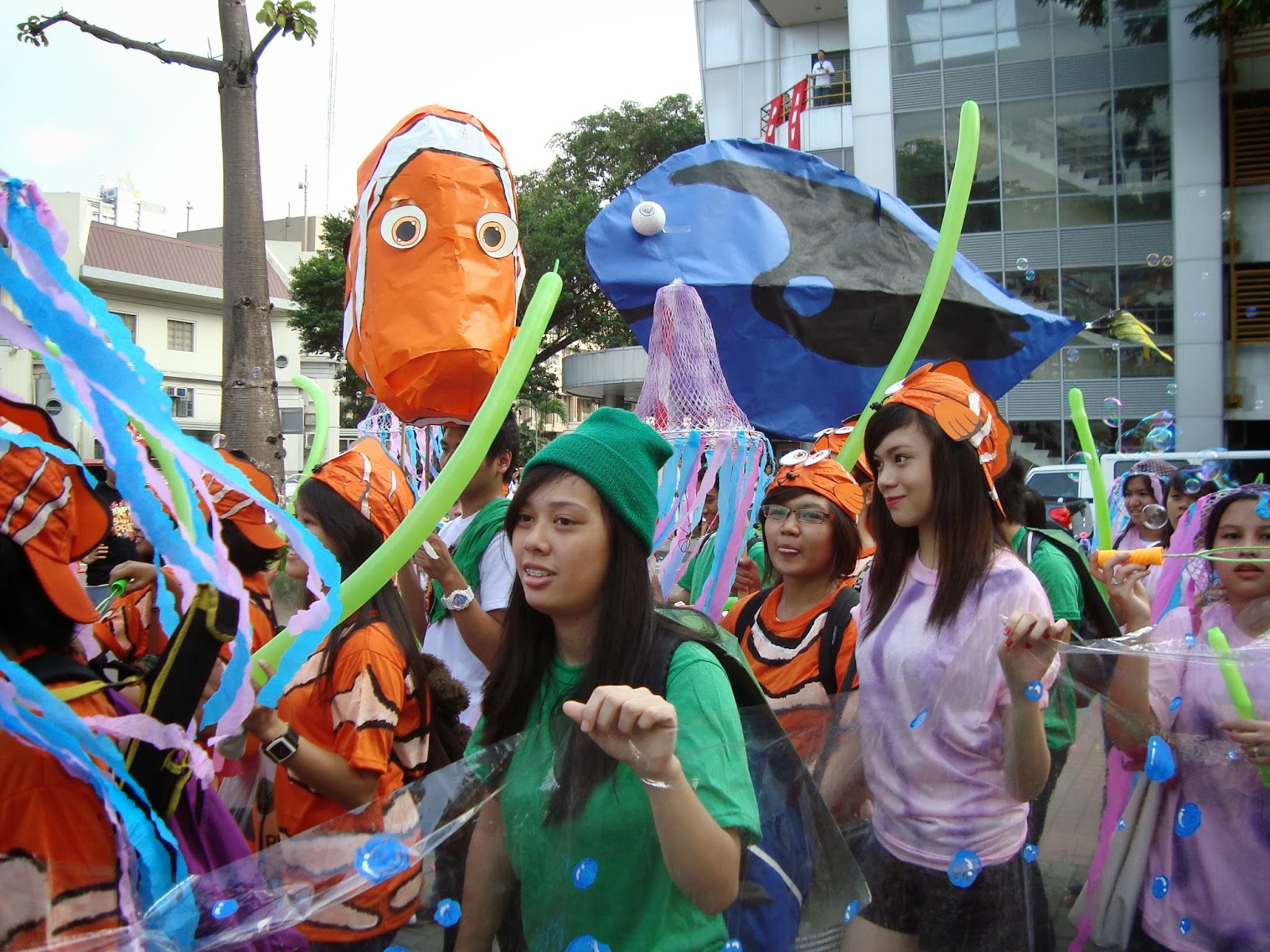
Finding Nemo, the friendly fish


Of old cultures and postmodern


And adventure with the imagination …