Wednesday, May 7, 2014

Faces of Birds and Fowls

Photos by Abe V Rotor and Marlo R Rotor
Guinea Fowl
Pigeon
Lovebirds
Emu
Mallard Duck
Hawks
Peahen
Goose
Peacock Pigeon


Faces, faces, which are happy, which are sad?
     I don't know in my world;
When you are free and when you are a slave,
     rather save an unkind word.

You yielded to man's demand to leave the wild
     all for his civilization;
You left your kind in the forest and in the sky
     to your last bastion.

You are on stage for children and grownups
     in respite from life's many bind;
I wonder what you have where you came from,


     perhaps one of a kinder kind. ~

Saturday, May 3, 2014

Fusion - Path of Evolution

Fusion - Path of Evolution
Dr Abe V Rotor


Sargassum fish cleverly intertwined and camouflaged, exhibiting combined  characteristics of plant, animal, and protist, the natural landscape under the sea, notwithstanding.   Paintings in acrylic on glass AVR c. 2003

Evolution is when the simple becomes complex,
    and the complex into intricate;
yet the intricate to complex, reverting into simple,
    when fail the process to replicate.

Evolution is forward and backward through time,
     simultaneous, spontaneous;
a explosion of diversity of all kinds imagined,
     in chains, webs and continuous. 

Evolution is untrodden, unguided, by chance
     in a million possibilities beyond
the eye or lens, and probing mind and will,
     in the depth of sea, or just around. 

Evolution is de-volution, shrinking, thinning -
     extinction by nature and by man - 
plant-animal fusing, moneran-protist pooling;
     prelude to a living world gone. ~

Pet Birds - are they?

Dr Abe V Rotor


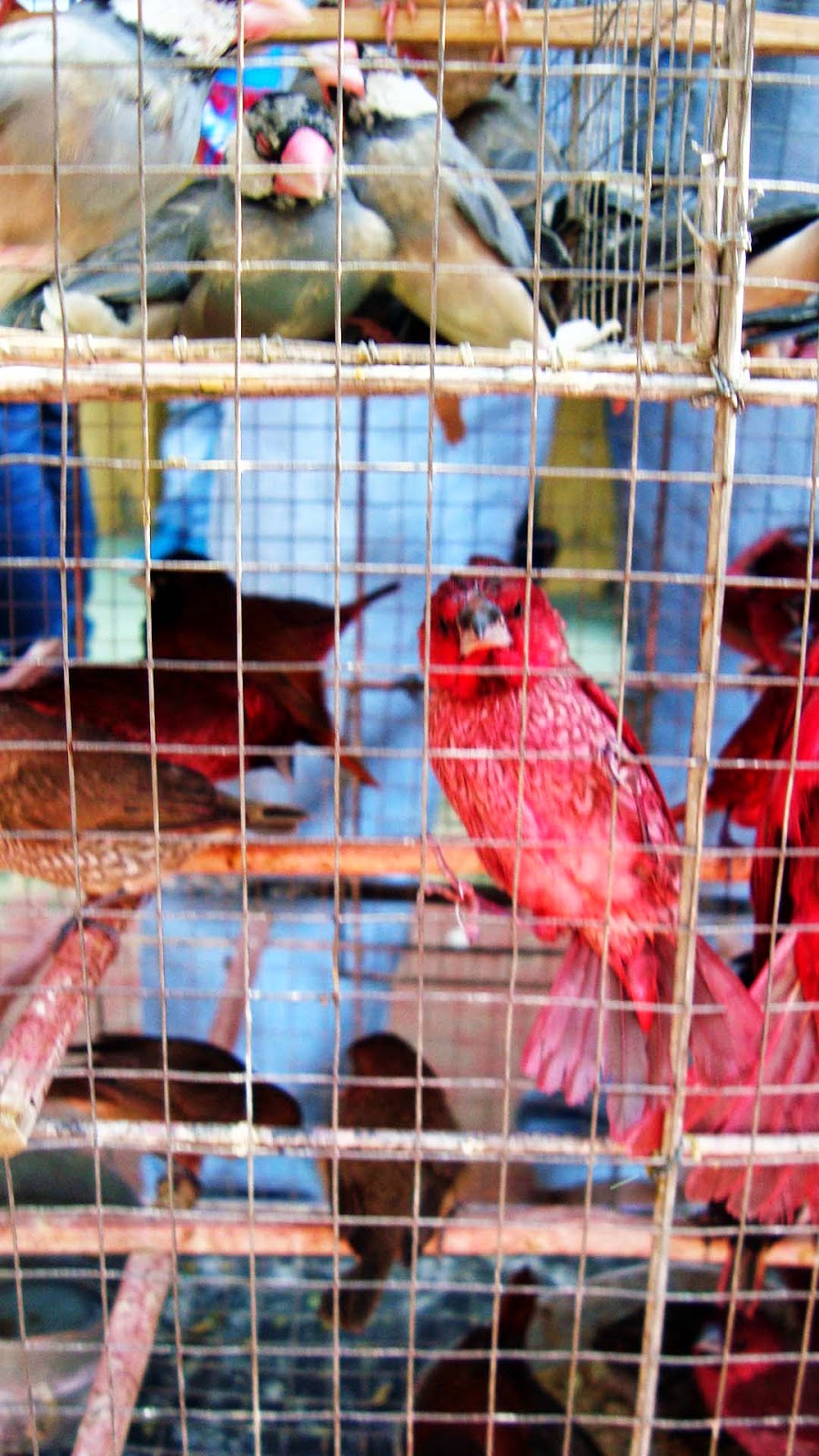
Birds in captivity is a great attraction to children. Here finches of different kinds are sold in small cages. Birds are the freest creatures.  They die in captivity by exhausting themselves to death trying to get out of their confines. 

Pet birds in cages weaned from their nest,
to market, to market, but why the haste?
Children are waiting, urging their parents  
to buy them pets - but what a waste! 

A pet is a pet, and curiosity is not enough,
short live impulse, deep ignorance;
and poor child, the world is beyond him, 
to understand the difference.

Pet is freedom, pet is love, it is mutual;  
not in the cage but in trees singing,
a family and whole flock, it's a part of,
not money but freedom - or nothing. 

The children's faces are full of desire
but not of love's true expression;
Reverence for Life they must be taught;
we grownups, it's our mission. ~    
  
Artificially colored maya appear unique, it may be mistaken for another species, perhaps a rare one to the innocent customer. Colors are harmful to both birds and man because of their lead content. 
Day old chicks are made to appear unique and "beautiful" by dyeing 
and painting them with different designs. 
Can you tell what these children are thinking about? Palm on check with 
serious expression maybe the turning point of reason - "if you were in the 
shoes of someone." Would you be happy if you were inside a cage? 


Colored day-old chicks are deceiving. It is not fair to the children, it is not fair to the Creator.   

Friday, May 2, 2014

Don't be Afraid of the Death-watch Beetle

Dr Abe V Rotor
It’s like an Edgar Allan Poe’s story of death tapping on “a night dark and dreary”, but in this case it is not a raven. It is the Death-watch Beetle (Xestobium rufovillosum) that is alluded to death. It is an insect with a scary habit all right.

Death-watch Beetle (Xestobium rufovillosum)

The name was derived from the tapping sound it produces, which is frequently heard during mating period, usually in April or May.

The beetle simply jerks its body forward in rapid succession, and strikes each time with the lower front part of its head against the surface on which it happens to be standing. It gives eight taps in slightly less than a second; and almost before it stops another beetle of its kind that is within hearing distance will respond by tapping back in the same quick manner. In woodwork and furniture that have been attacked by the Death-watch Beetle, the worm holes are large and distinguished by the presence of frass and powder around the openings.

The beetles are from one-fourth to one-third of an inch in length, dark brown in color, spotted and banded irregularly with thick patches of short yellow gray hairs. Pairing takes place after the beetles have made their exit from the wood, and they die a few weeks later, the female in the meantime having laid some 70 eggs. The tapping is of the nature a sexual call, and may be repeated over and over for quite a long time. Grating sound may also be heard as the larvae gnaw on wood inside its tunnel. It takes three years to complete the insect’s life cycle. A more familiar beetle, Anobium punctatum, is called powder post or furniture beetle, named after the dust it scatters at the mouth of its tunnel on furniture.
 Powder around the holes (left),  leading to the tunnels (right).
Powder post beetle, Anobium punctatum  

Well, it's just the death-watch beetle or the powder post beetle; there's nothing to fear about.
But don't wait until your furniture falls apart, or your house falls down. ~

Living with Nature, AVRotor; acknowledgment: Encyclopedia Britannica, Google

The Enigmatic Antlion

Playing the ukoy-ukoy game is fun!
Dr Abe V Rotor
Living with Nature School on Blog
Paaralang Bayan sa Himpapawid (People's School-on-Air) with Ms Melly C Tenorio
738 DZRB AM Band, 8 to 9 evening class, Monday to Friday      

When we were kids we played the ukoy-ukoy game.  It's a strange game to city bred kids.  But in the province, when it is summer and the place is dry and sandy, the ukoy-ukoy - larva of the ant lion - is a odd thing we played with.  It is a fishing game.  

Catching antlion larvae

We would tie one of the fangs (mandible) with a strand of fine hair and fish out another larva in its own hole.  The resident larva sensing an intruder picks a fight and doesn't let go our decoy.  Then we would lift both slowly and put our catch in a jar. After comparing who got the most catch and the biggest, we simply returned the poor larvae into the sand and watched them make new pits, while others would simply scamper leaving a doddle trail, before sinking into the sand. It's a dirty game - hands, face and knees - but how we loved the game! It's one for the book of Guinness.   
An ant falls into the pit trap of the antlion larva. Like falling into a quicksand the ant struggles only to fall back into the center of the pit. Beneath waits the assassin. It seizes the victim, paralyzes it by injecting poison from its fangs (mandibles) and drags it into the abyss where it enjoys its meal.
The antlion larva looks like a monster from outer space, barely resembling an insect that we typically know. It is seemingly docile but aggressive the moment a prey falls into its pit trap.  After devouring it with a pair of  scythe-like mandible, it rebuilds its pit, and waits for the next victim.  The abdomen is extraordinarily large in proportion to its head and thorax. One explanation to this is that the antlion larva has no anus. All the metabolic waste that is generated during the larval stage is stored and is eventually emitted as meconium near the end of its pupal stage.  The larva makes a globular cocoon of sand stuck together with fine silk spun from a slender spinneret at the posterior end of the body. This hard and thick shell protects the quiescent pupa deep below its former pit.  It remains there for one month, emerging into an adult fly.
The adult may be mistaken for a dragon fly or damsel fly - or a lacewing insect - for its flimsy wings, but it is not related to any of them. It is one kind of insect that the adult is a far cry in appearance from its immature forms. After three or four moultings it turns into a cocoon, then emerges and climbs to the surface, flexes its wings, then flies about in search for a mate. The adult has an extremely thin, flimsy exoskeleton, with the two pairs of wings showing prominent and intricate venation, for which the insect is classified under Order Neuroptera. .
The antlion (Myrmyleon sp) undergoes a complete life cycle (holometabola).  It lives in two different environments, although both larva and adult have predatory habits. The larva lives mostly on ants that blunder and fall into its death trap, pouncing on them like a lion, hence its name.  


Acknowledgement: Wikipedia, Internet

Can we harness energy from plants, rather than harvest energy from their products?

Dr Abe V Rotor

As a simple review, only plants - green plants (those containing chlorophyll which include algae and relatives) - have the ability to capture solar energy and convert it into chemical energy. That is, the light of the sun into sugar (calories), by means of photosynthesis. 

Sugar (CHO) is either transformed into energy for the use of the plant itself, or transferred to animals that feed on the plant.  

Otherwise this primary product is stored into complex sugar like starch, oil, and more importantly protein (CHON) which is used as "building blocks" in growth and development. Post-photosynthetic processes are specific in the production of resin, gum, cork, wood, and many other organic compounds, which when taken by animals are converted into energy, and compounds needed  in their growth and development. Otherwise the unused materials remain at store, or may be lost through oxidation though biological (e.g. fermentation) and physical means (e.g. burning).

Energy is a continuous, incessant  flow in the living system, moving in and out in the process. Biologists explain it in terms of metabolism (catabolism or energy-gain, and anabolism or energy loss or respiration), whereas ecologists draw the lines of interrelationships of participating organisms as food chains forming food webs, and food pyramid to indicate hierarchy in energy utilization. . 
 
 Intricate network in a leaf through which energy and materials flow.


But as a basic principle plants are autotrophs (photosynthesizers), while animals are heterotrophs (consumers in hierarchical order, with man being the ultimate consumer in most cases).    

With this in mind, how can we the harness solar energy in the plant during photosynthesis? 

How can we create a short circuit in directing the electrons before they are used in the final stage of photosynthesis - and instead, convert it directly into electricity?   

We can - theoretically - if we can only develop a method to “interrupt” photosynthesis and redirect the electrons before they are used up to make sugars. So instead of harvesting sugarcane, and make alcohol, and burn it to produce light and heat – or electricity -  we might as well invent a living solar panel and directly "harvest" electricity for our domestic and industrial needs.

Sounds futuristic, isn’t? Well, it is. But remember, no one believed in splitting the atom a century ago and produce nuclear energy. There are now hundreds of nuclear plants all over the world, producing electricity to as much as 50 percent of a country’s electricity need.  Such is the case of France, Germany and Japan.

How about hydrogen fuel? There are cars - thousands of them running on Hydrogen fuel. And the byproduct is not smoke that add to pollution. It is H2O or water.  

Now, hear this. During photosynthesis, the photons that are captured by the plant are used to split water molecules into the component parts of Oxygen andHydrogen. By doing so, they produce electrons. The electrons are then utilized by the plant to create sugars that are then used by the plant (and the animals that eat it) for growth and reproduction.

Architecturally the leaf is like a battery.

"The technology involves separating out structures in the plant cell called thylakoids, which are responsible for capturing and storing energy from sunlight. Researchers manipulate the proteins contained in the thylakoids, interrupting the pathway along which electrons flow. 

These modified thylakoids are then immobilized on a specially designed backing of carbon nanotubes, cylindrical structures that are nearly 50,000 times finer than a human hair. The nanotubes act as an electrical conductor, capturing the electrons from the plant material and sending them along a wire." 
(Reference: Ramaraja Ramasamy, assistant professor in the University of Georgia and the author of a paper published in the Journal of Energy and Environmental Science.) 
This research is important, because photosynthetic plants function at nearly 100% quantum efficiency. Almost every photon of sunlight captured by the plant is converted into an electron. And what do we get in our solar cells today? A measly fraction - 12 to 17 percent. This huge difference propels us to research towards this direction, away from fossil fuels, and even from the circuitous biomass fuel generation. 


Tree-planting project, Mt Makiling, Laguna

Harvesting electricity directly from plants may be weird and wild an idea as in Jules Verne fiction novels.  But now we can go Around the World in Eighty Days - and even reach the moon and explore outer space. We can now go deeper than Twenty Thousand Leagues Under the Sea and even reach the ocean floor.

And how about coming up a perpetual machine, elusive dream child of science?
The answer may lie in Plant-Based Energy Generation. ~

Thursday, May 1, 2014

Fast Compost Making with Wild Sunflower


Dr Abe V Rotor
Living with Nature - School on Blog
Paaralang Bayan sa Himpapawid (People's School-on-Air) with Ms Melly C Tenorio; 738 DZRB AM, 8-9 evening class Monday to Friday

Wild sunflower, Tithonia diversifolia may have been introduced into the Philippines from Mexico by the Spaniards.

 Who would have thought that those shrubs with bright yellow flowers growing by the roadsides or wastelands make excellent organic fertilizer?

      Wild sunflower, Tithonia diversifolia, has been found to contain high levels of nitrogen content, exceeding nearly six percent. It has enzymes that hasten decomposition and cut down composting time from three months to just a few weeks. This is why it is an excellent additive for composting rice hay and other farm wastes, materials which have low nitrogen contents, decomposition.

      Sunflower added to compost piles builds heat and sustains it at a high level of over 55 degrees Celsius. At this temperature weed seeds and harmful microorganisms are killed, including those that cause acidic reactions.  Acidic soil “locks up” nutrients that are otherwise made available for plant use.

      With the addition of chopped sunflower into the compost pile, its pH value remains at seven to eight pH (neutral to slightly alkaline), throughout the decomposition period.  Under this condition nitrogenous materials are immediately mineralized into ammonium nitrogen (NH4N+) and nitrate (NO3) which are directly absorbed by the plants.

      These are highlights of a graduate research study by Prof. Luisito Evangelista at the University of Santo Tomas for a masteral degree in biological science.  “Accelerated composting is the key to successful production of on-farm organic fertilizer, specially in areas where sunflower abounds,” Evangelista claims. 

      In areas where the inoculant is not available, sunflower is an alternative to Trichoderma a cellulose-acting fungus strain developed by Dr. Virginia C. Cuevas of the Institute of Biological Sciences at UPLB.  

      When the sunflower-activated compost was used on Red Creole onions, yield increased by as much as 20 percent, while the physical quality of the bulbs improved.  Other than being bigger, the bulbs are brighter, heavier and more uniform in size. Their necks are well closed, reducing the danger of rotting during storage.

      Here are ways to make sunflower compost:

1.  Prepare a well-drained area, half shaded if possible.  Here, construct a compost pile of 2 x 4 meters in dimension, and breast high when compacted.

2.  Prepare the raw compost materials by chopping the rice straw and green wild sunflower separately.  The ratio by weight of sunflower to rice hay is 3:1.  Ready chicken droppings (or animal manure) and topsoil from the farm.

3.  Pile these materials in the following arrangement: the rice hay makes the first layer, 20 cm thick.  On top of layers are the chopped sunflower, followed by manure and soil.

4.  Make a second set of layers on top of the first, compacting the pile as the process is repeated. The pile should not be higher than 1.5 meters for convenience in watering and turning over.

5. Vertically insert aeration tubes made of bamboo poles onto the pile 50 cm apart. The tubes are made by partly opening the nodes, outside and inside to allow air to enter and for heat to rise.

6.     Monitor temperature with a thermometer inserted through the tubes.
Heat is expected to increase immediately, reaching its peak within two weeks before it declining.

7.  Maintain watering sufficient to keep moisture content at 60 to 70 percent.  Use plastic or burlap sacks to cover the pile, protect it from rain, and help conserve the heat generated.

8.  As decomposition progresses, the pile will shrink and the temperature will soon equal that of the surroundings. After three to four weeks, the compost is “ripe” for harvesting.  To facilitate the process, turn the pile once or twice  before reaping.
    
To know if the compost can now be used, here are the indicators:
· Make sure there is no foul odor emitting from the pile.
· The temperature must have dropped and is about the same as that of the surrounding area.
· The original substrates are no longer recognizable.
· The color is dark, loamy and soft to the touch.

     Composting is a bio-oxidative process, which results in the production of a stable organic product, contributing directly to soil conditioning and fertility. In many books, it is called mineralization, or the breaking down of organic compounds into their elemental forms and as they settle down in the soil. This process is particularly true with nitrogen. This is nature’s way of recycling chemical compounds, from organic to inorganic form, and vice versa.

      Composting rice hay alone is not advisable as it has a low C:N ratio.  This is the reason why farmers seldom convert rice hay (or corn stover) into compost. They would rather use rice hay roughage, or kindling for fine.

      In terms of dry weight, rice hay contains very low nutrients - 0.86 percent Nitrogen, 45.91 total Carbon, 0.16 Phosphorus, 2.84 Potassium.  Compare this with the analysis of dry farm manure (carabao): 1.02 N, 10.66 C, 5.33 P and 1.92 K, whereas dried wild sunflower contains 5.53 N, 55.83 C, 0.36 P, and 2.78 K.  Soil on the other hand contains 0.13 N, 1.49 C, 28.36 P and 0,01 K.

      It is clear that the incorporation of topsoil, manure and wild sunflower in the compost pile will boost nitrogen (N), carbon (C), Phosphorous (P) and Potassium (K) elements therefore, increasing the nutrient value of the finished compost.

      This means that the C:N becomes closer to 30:40 the more valuable a compost it becomes, while the rate of decomposition is accelerated. By maintaining moisture content at 60 to 70 percent and temperature at 50 degrees centigrade in the initial two weeks, the pH level stabilizes at 6 to 8pH.  This is favorable to the development of biological and chemical reactions.  

      Composting then, basically, is following nature’s formula.  In nature, crop residues are left on the field after harvest and allowed to decompose or be eaten up by animals, was likewise leave their dropping on the ground. In both cases, the end products become part of soil together with weeds and other plants that are normally incorporated during plowing. This may be augmented by green manuring, the planting of leguminous plants like Indigo (Indigofera hirsuta L) which is purposely incorporated into the soil before the planting season.

      This system traditional practice, holds the key to sustainable productivity of centuries-old farmlands. It is also common in agricultural societies throughout the world, having evolved naturally. Traditional farming, after all, is a shared experience with man living in harmony with nature.  What type of judgment can man give to modern agriculture which uses synthetic inputs, offering high production outputs, but leaving the farms despoiled in the process?    

      Perhaps we should turn our attention to another example of natural composting.  The floor of a forest is continuously being built by composting.  It is a living carpet inhabited by a complex population of organisms responsible for converting organic materials into inorganic and elemental forms. These are then recycled, down to the succeeding generations of organisms.
 Closeup of the flowering plant  

      Natural composting is also observed in insect eating plants like the pitcher plant and the sundew.  It is demonstrated in the watery axils of bromeliads (tropical American herbaceous plants like pineapple or Spanish moss), which trap water and dirt. This mini pool is home to wrigglers, frogs, fish and reptiles. It is no wonder how bromeliads can live an epiphytic (living on the surface of plants) existence without reaching the soil for subsistence.

      The ant plant is another example.  Its bulbous rhizome (causing to take root) is filled with a colony of ants that “eat” through a complex tunnel network.  The inside is a laboratory which produces organic materials that the plant uses for its growth.  This is a classical example of symbiosis.
      Next time you find wild sunflowers growing where a lot of farm residues are available but wasted, think of the potential organic fertilizer that can be produced. It is the key to natural and environment friendly farming.  In nature, nothing is wasted. ~