Sunday, November 16, 2014

Museo de Santa Monica, Roxas City, Capiz

In Memory of the Very Rev Msgr Benjamin F Advincula, PC, Episcopal Vicar for the Clergy, Archdiocese of Capiz, and Fr N Abalajon of Santa Monica Parish, Roxas, Capiz
Dr Abe V Rotor

The museum is housed in a renovated convent beside the old church.
Church of Sta Monica originally built in the 17th century
National Historical Marker. The old church itself is a museum.  
Memorabilia


Centuries-old relics and icons
Gasera, oil lamps

Altar made of carved and molded silver plate
Mediogori Mother and Child icon
Blessed Sacrament
Relics and carved wooden table-chest
Original altar piece
St. Augustine
Author pays respect to the dead Christ; sacred garments (above)

Map of the Province of Panay

Sta Monica, tabenacle, halo of gold and silver
German accordion; Microphone, WWII

Acknowledgment: Very Rev Msgr Benjamin F Advincula, PC Episcopal Vicar for the Clergy, Archdiocese of Capiz; Santa Monica Parish; and Museo de Santa Monica curator and staff; Rev Msgr Vicente F Kilata, Rev Fr Vic Bendico, Fr Anthony Bautista, Fr Mark Granflor, Fr Nonoy Abalajon, Fr Noel Abalajon, Fr Robert Alba, Bro Ray Bofill et al

Saturday, November 15, 2014

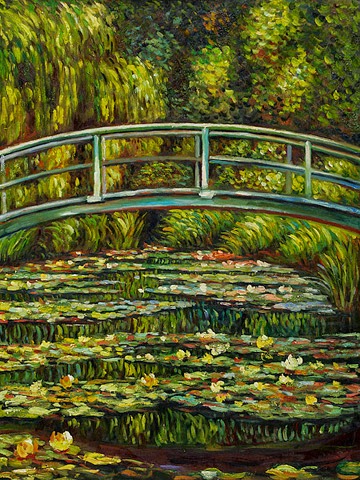
Pond Waterlilies - Monet's Signature


Fusion - Path of Evolution

Evolution is forward and backward through time,
      simultaneous, spontaneous;
an explosion of diversity of all kinds imagined,
      in chains, webs and continuous. 
Dr Abe V Rotor


Sargassum fish cleverly intertwined and camouflaged, exhibiting combined  characteristics of plant, animal, and protist, the natural landscape under the sea, notwithstanding.   Paintings in acrylic on glass AVR  c. 2003

Evolution is when the simple becomes complex,
      and the complex into intricate;
yet the intricate to complex, reverting into simple,
      when fail the process to replicate.

Evolution is forward and backward through time,
      simultaneous, spontaneous;
an explosion of diversity of all kinds imagined,
      in chains, webs and continuous. 

Evolution is untrodden, unguided, by chance
      in a million possibilities beyond
the eye or lens, and probing mind and will,
      in the depth of sea, or just around. 

Evolution is de-volution, shrinking, thinning -
      extinction by nature and by man - 
plant-animal fusing, moneran-protist pooling;
      prelude to a living world gone. ~

Accelerated composting with wild sunflower

Dr Abe V Rotor 

Who would think those shrubs with bright yellow flowers growing on the roadside and wastelands make excellent compost? 

Wild sunflowers, painting in acrylic by AV Rotor 

Natural vegetation of wild sunflower, Tithonia diversifolia 
Wild sunflower, Tithonia diversifolia, has been found to contain high nitrogen content, exceeding nearly 6 percent, and enzymes that hasten decomposition and cut down composting time from three months to just a few weeks. This is why it is an excellent additive in composting rice hay and other farm wastes which have low nitrogen content and which normally decompose slowly.

Sunflower added in the compost pile builds heat and sustains it at a high level, 55 degrees Celsius on the average. At this temperature weed seeds and harmful microorganisms are killed, including those that cause acidic reaction. Acidic soil locks up, so to speak, nutrients that are otherwise made available for plant use.

With the addition of chopped sunflower in the compost pile, its pH value remains at 7 to 8 (neutral to slightly alkaline), throughout the decomposition period. Under this condition nitrogenous materials are immediately mineralized into ammonium nitrogen (NH4N+) and nitrate (NO3) which are directly absorb by the plants.

These are highlights of a graduate research at the University of Santo Tomas leading to a masteral degree in biological science by Luisito Evangelista, a professor at Siena College QC.

“Accelerated composting is the key to successful production of on-farm organic fertilizer specially in areas where sunflower abounds,” Evangelista concludes.

Sunflower is an alternative to Trichoderma a cellulose-acting fungus strain discovered by Dr. Virginia C. Cuevas of the Institute of Biological Sciences at UPLB especially in areas where the inoculant’s is not available. 


When the sunflower-activated compost was used on Red Creole onions, yield increased by as much as 20 percent, and the physical quality of the bulbs improved. Other than being bigger, the bulbs are brighter, heavier and more uniform in size. Their neck is well closed and this is important in storage as danger of rotting is reduced. 

How can one make his own sunflower compost? Here is how. 

1. A well drained area, half shaded if possible, is prepared. Here a compost pile of 2 x 4 meters in dimension, breast high when compact, will be constructed.

2. The raw compost materials are prepared by chopping the rice straw and green wild sunflower separately. The ratio by weight of sunflower to rice hay is 3:1. Chicken droppings or animal manure and topsoil from the farm are also readied.

3. These materials are piled in the following arrangement: the rice hay makes the first layer, 20 cm thick. On top of it is the chopped sunflower, followed by manure and soil.

4. A second set of layers is made on top of the first, compacting the pile as the process is repeated. The pile should not be higher than 1.5 meters for convenience in watering and turning over.

5. Aeration tubes made of bamboo are planted vertically into the pile 50 cm apart. The tubes are made by partly opening the nodes, outside and inside to allow air to enter and heat to rise.

6. Temperature is monitored with a thermometer inserted through the tubes.

Heat is expected to increase immediately reaching its peak for two weeks before it gradually declines.

7. Watering should be just sufficient to maintain moisture content of 60 to 70 percent. Plastic or sacks are used to cover the pile to protect it from rain and to help conserve the heat generated.

8. As decomposition progresses the pile will shrink, and temperature will soon equal to that of the surroundings. After three to four weeks the compost is “ripe”. To facilitate, the pile is turned once or twice before it is harvested. 


To know if the compost can now be used, here are the indicators. 

· There is no foul odor emitted by the pile.

· Temperature has gone down and is about the same as that of the surrounding area.

· The original substrates are no longer recognizable.

· The color is dark, loamy and soft to touch. 
Composting is a bio-oxidative process, which results in the production of stable organic product that contributes directly to soil conditioning and fertility. In many books it is called mineralization, that is, the breaking down of organic compounds into their elemental forms and as they settle down in the compost or in the soil as may be the case, become available to plants. This is particularly true with nitrogen. This is nature’s way of recycling chemical compounds, from organic to inorganic form, and vice versa. 

Composting rice hay alone is not advisable as it has low C:N ratio. This is the reason farmers seldom convert rice hay – and also corn stover - into compost but would rather have other uses, such as roughage, if not burn them.

In terms of percentage of dry weight, rice hay contains very low nutrients - 0.86 Nitrogen, 45.91 total Carbon, 0.16 Phosphorus, 2.84 Potassium. Compare this with the analysis of dry farm manure (carabao): 1.02 N, 10.66 C, 5.33 P and 1.92 K, whereas dried wild sunflower contains 5.53 N, 55.83 C, 0.36 P, and 2.78 K. Soil on the other hand contains 0.13 N, 1.49 C, 28.36 P and 0,01 K.

It is clear that the incorporation of top soil, manure and wild sunflower in the compost pile will boost these elements – N, C, P and K - and therefore, increases the nutrient value of the finished compost. 


This means that the C:N becomes closer (30:40) making it more valuable as compost, while accelerating the rate of decomposition. By maintaining moisture content at 60 to 70 percent and temperature at 50 degrees centigrade in the initial two weeks, the pH level stabilizes between 6 to 8 that are favorable to both biological and chemical reactions taking place. 
Composting then basically follows nature’s formula. In nature, crop residues are left on the field after harvest and allowed to decompose or eaten by animals that in the process leave their waste on the ground. In both cases the end products become part of soil together with weeds and other plants that are normally incorporated during plowing. This may be augmented by green manuring, the planting of leguminous plants like Indigo (Indigofera hirsuta L) which is purposely incorporated into the soil before the planting season. 

We may call this system traditional for the reason that it is an old practice, yet it holds the key to sustainable productivity of centuries-old farmlands. It is also common in agricultural societies throughout the world as if it evolved naturally. Traditional farming as I see it is a shared experience with man living in harmony with nature, respecting her ways and law. What judgment can we give to modern agriculture which use synthetic input and offer high production but leave the farms unproductive and spent on the long term? 

Perhaps we should turn our attention to another example of natural composting. The floor of a forest is continuously being built by composting. It is a living carpet inhabited by a complex population of organisms responsible in converting organic materials into inorganic and elemental forms that are recycled to the living world, and down to the next generations of organisms. 

Natural composting is also observed in insect eating plants like the pitcher plant and the sundew. It is demonstrated in the watery axils of bromeliads, which trap water and dirt. This mini pool is home of wrigglers, frogs, fish and reptiles. It is no wonder how bromeliads can live an epiphytic existence without reaching the soil for subsistence. 

The ant plant is another example. Its bulbous rhizome is filled with a colony of ant that “eats” a complex tunnel network. Here inside is a laboratory that produces organic materials that the plant uses for its growth and development. This is a classical example of symbiosis. 


Next time you find wild sunflowers growing around where there are a lot of farm residues that simply go to waste, think of the potential organic fertilizer that you can produce. It is the key to natural and environment friendly farming. In nature, there is nothing called waste. ~

Thursday, November 13, 2014

UST Paskuhan - A University Tradition

UST Paskuhan - A University Tradition
Dr Abe V Rotor
Professor, UST
Ang UST Paskuhan ay ang taunang pagdiriwang ng Unibersidad ng Santo Tomas (UST) sa panahon ng Pasko. Ito ay kinatatampukan ng parada ng mga karosa ng mga iba't ibang institusyon sa loob ng UST sa hapon kasunod ang isang engrandeng palatuntunan sa gabi, kung saan mapapanood ang mga awitin at tugtugan ng mga mang-aawit at banda ng unibersidad, gayundin ang iba't ibang patimpalak at production numbers. Nagtatapos ang Paskuhan sa pamamagitan ng isang fireworks display. (These are footages of previous UST Paskuhan.  Acknowledgement: The Varsitarian, UST Admin, Central Student Council, Internet, UST Website.  
Paskuhan
Primered by the Eucharistic Celebration, the Paskuhan is the Thomasian way of celebrating Christmas. It is one of the most awaited events of the year showcasing different performances from different student organizations, and live bands, which is complemented with an extravagant show of pyrotechny.  In the 2011 celebration, the crowd was estimated at 100,000.

The Christmas Concert
The UST Christmas Concert features talents from the UST Conservatory of Music, UST Singers, Coro Tomasino, Liturgikon, Conservatory Chorus Class, and the UST Symphony Orchestra. Traditional Filipino and foreign Christmas classics are performed in the event. At the end of every concert, the UST Symphony Orchestra and performers lead the audience in singing some songs such as 'Ang Pasko ay Sumapit.'