Thursday, January 17, 2019

Sail Boats Forever

Dr Abe V Rotor


Sailboats in acrylic, AVR c. 2004


What a crude game, you may say, 
Of my ancestors’ sailboats catching 
The breeze, docking the gusts, 
Edging the rocks, sans compass 


Or sextant, map and telescope. 
What prize is at stake? Not a trophy. 
Yet the instinct craves for a prize 
Like in The Old Man and the Sea; 


A prize he found, mindless of people. 
Who saw nothing of his adventure. 
Let the sailboats play in the wind 
And water, let alone an old boat 


At rest, sitting on rock like an old man, 
whose time has come but not his aim, 
Still on guard over the young, who too, 
Shall someday play the same old game. ~


Mystery of Life from its Beginning and End - and In Between

When a meteor got too close to earth and blew a breath of life. Could this be the beginning of life on Earth?
Dr Abe V Rotor
Bryophytes and fern carpet a boulder. Closeup photos
Mosses and algae cling on boulder and living trunk of Albizzia tree 
(Photos taken at the Ateneo de Manila University, Diliman QC

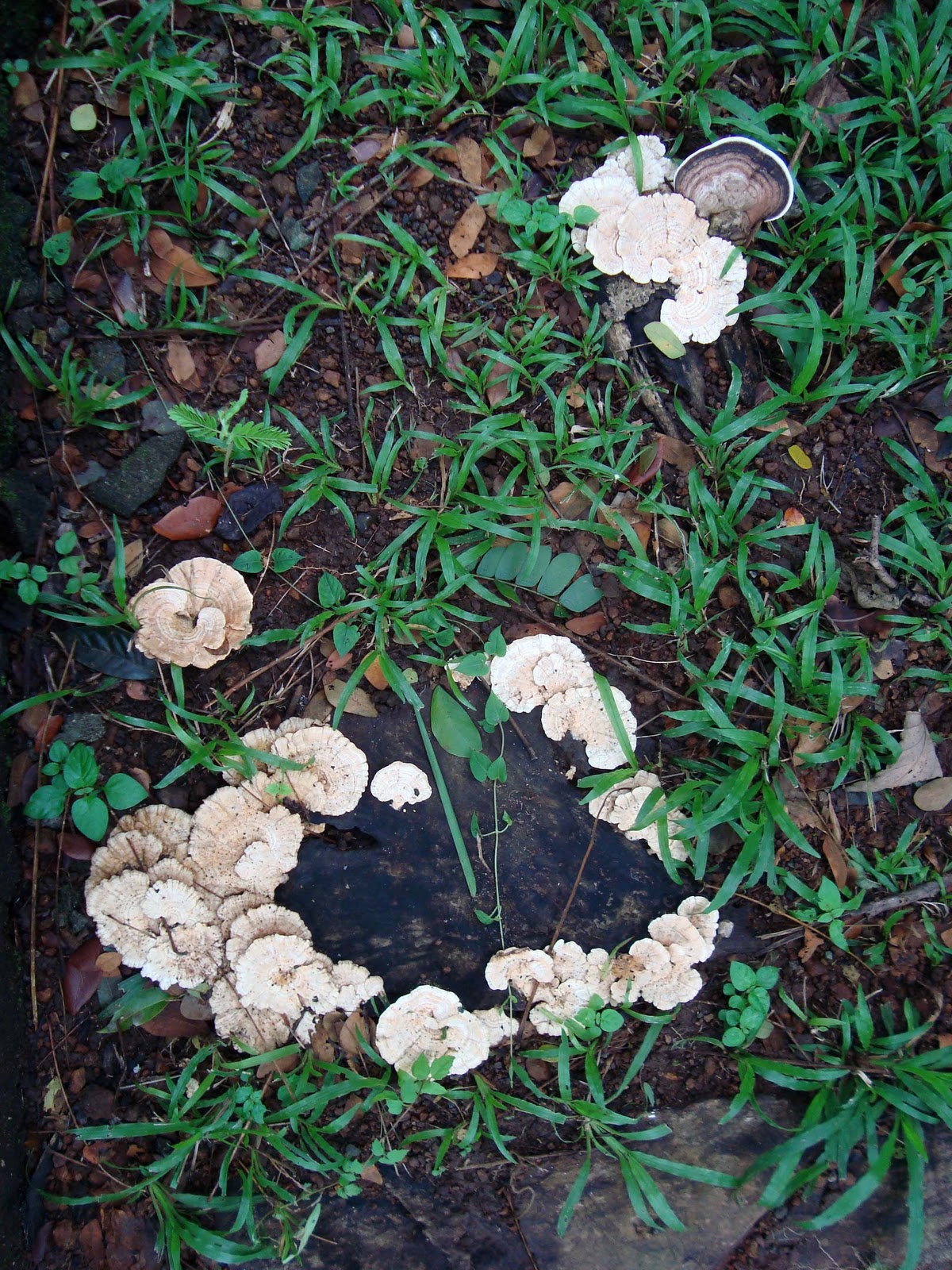
Shelf mushrooms colonize tree stumps, living on lignin and cellulose 
and breaking them into elemental form.

When does life start? 

When volcanoes settled into ash

three billion years ago.

When a meteor got too close to earth

and blew a breath of life.

When the virus' chemical bond deceives

a host cell as foster parent.

When a giant protein molecule became a blob

in the vast ocean of soup.

When paedogenesis rules over fertilization

and results in virgin birth.

When the stem cell predestined as embryo,

is also reserved as tissue or organ.

When plants, animals and protists are disguised

as gametophytes and sporophytes.

When countless spores disseminate with few

survivors finding foothold somewhere.

When mosses and algae carpet a rock,

die and resurrect the next season.

When mycellia long laid to rest wake up

to lightning and become mushroom.

When sulfur bacteria colonize volcanic craters

on land and on the ocean floor.

When fission, budding, cutting, tillering,

defy aging and mutation.

When does life end? 


When the world comes to a fiery end
five billions years from now.

When a comet gets too close

or a huge meteor falls to earth.

When the last member of a population

bids farewell to the species.

When the last forest is razed, coral

reef leveled, rivers reclaimed.

When flu virus becomes interactive

in three-way of more circuit.

When global warming shrinks the continents

and submerges the islands.

When the glaciers lay the mountains bare;

rivers, lakes and streams run dry.

When farms and pastures, and valleys

turn into wastelands.

When genes are engineered to befit

man's greed, but bereft the species.

When population can be contained no more

and the finite resources reach the limit.

When Malthus ghost is back with the grim

four horsemen of the Apocalypse

When intelligence makes man a robot,

and robot becomes man. ~

Everything on earth undergoes a cycle,

Everything on earth (and in the universe) undergoes a cycle, a beginning and an end, and in between a period of growth, stability and senescence. Yet no cycle could succeed unless it is part of an interrelationship with and among other cycles in the biological and physical world, each lending a vital role aimed at a holistic and perpetual oneness apparently designed by an unknown hand. 
 Dr Abe V Rotor

    Life cycle of each of these organisms - mosquito, Gambusia fish, Spirulina alga, man, together with tie parasites and symbionts, interact in a complex web - the web of life that constitutes a ecosystem  

Cycle and recycle is the principle key to homeostasis that maintains the integrity of the biosphere, and the whole Planet Earth . Everything is tuned to a cycle - the passing of seasons, alternation of generations, food web and food chain, “natural” clocks, ecosystem seres, etc. And none of these can work without being part of a complex pattern of inter-relationships.
 Recycle Farm Wastes
1. The moist common materials for composting in the farm are rice straw, peanut and mungo hay, banana stalk, corn stover, Azolla, ipil-ipil, wood and coconut shavings, livestock wastes and chicken droppings, pond scum, water lily and weeds.

2. Actually we get so little of the fertilizer value we put into a crop as shown by this typical fertilizer efficiencies.  
·         30 to 60 % for N,
·         10 to 35 % for P, and
·         15 to 30% for K.
 3. There are more nutrients removed from the soil that go into the straw than the grain. Here is a comparison. (Grain versus straw, kg nutrient/MT)
·         Nitrogen:     10.5 -    7.0
·         Phosphorus:  4.6 –    2.3
·         Potassium:    3.0 –  17.5
·         Magnesium: 1.5 –   2.0
·         Calcium:       0.5 -   3.5
 4. Rice straw contains 85-90 percent of potassium (K) of the biomass.  Thus much greater amounts of K must be applied to maintain soil supply where straw is removed.   

 5.  Small Water Impounding Projects (SWIP) are popular in many parts of the world where water is seasonal. Bigger ones can even generate electricity for locality. 

6. Recycle crop residues to raise livestock. Our Philippine carabao is perhaps the most efficient feed converter. Of the ruminant animals it has a digestive system that can extract sufficient nutrients from roughage, enabling them to survive long dry spells.  

7. Recycling with poultry makes use of farm by-products such as rice and corn bran, and reduces wastage in crops. Upgraded native chicken are more resistant than pure breeds, and are more resistant to pest and unfavorable weather. These chickens thrive on palay and corn; they forage in the filed, and glean on leftovers.  They are therefore, more economical to produce, tastier and free of antibiotic residues and artificial growth hormones.

8. Recycling with goats makes use of farm by-products and plants. Practically anything that grows in the field is food for goats, be it weed or crop. Thus they are very destructive to plants that they must be restrained in pens or tethered.   

9. Recycle wastes from market and kitchen Vegetable trimmings, and waste from fish and animals require efficient collection, segregation and processing into biogas and organic fertilizer. 

10. Recycling leads to the development of many products. Fruits in season that otherwise go to waste are made into table wine of different flavors. Typhoon or drought affected sugarcane make excellent natural vinegar and molasses.

11. Another recycling project is vermiculture, the culture of earthworms for game fishing and protein supplement in feeds.  Earthworm casting are excellent soil additives and conditioners for ornamentals and garden crops.

12. Hydroponics or soiless culture of crops, and organic farming are becoming popular worldwide.  Strict quality control is required, insuring consumers that the products were not treated with chemical fertilizers and pesticides, and should not contain a trace of toxic metals, radiation and dangerous contaminants.

13. Don’t throw away Nature’s Gifts, but tap them instead. Examples: Lantana camara as natural pesticide; oregano as natural medicine cough and sore throat;  chichirica as drug against cancer; pandan as spice and condiment; eucalyptus as liniment and cold drops; bunga de China for toothpaste, lagundi for fever and flu.  Many of these plants are taken for granted and many of them are considered weeds.   

Sunday, January 13, 2019

Spirituality with Nature: Give Me the Sky

Spirituality with Nature:  Give Me the Sky
Give me the sky symbolizes more than freedom, the realization of life's meaning, and beauty of living, humility and reverence. It reminds man of his role as guardian of creation.
 Dr Abe V Rotor

Skyview through the roof of Callao Cave, Peñablanca, Cagayan


Cirrus -stratus cloud formation under a tree
Give me the sky and I'll conquer darkness,
      even only a shaft through the rock;
Give me the sky and I will follow the sun
      from morn to evening and back.

Give me the sky and I'll watch the moon
      grow full and old and reborn;
Give me the sky and I'll chart the stars,
      the future and coming storm.

Give me the sky and I will ask the clouds
      to fall into rain and the fields green;
Give me the sky to greet the birds in flight,
      where they go, where they've been.

Give me the sky and I'll soar into space
      beyond the limits of the earth;
Give me the sky and I'll see from there
      the magnificent place of my birth.

Give me the sky and I'll keep it clean -
      the river, the lake and stream;
Give me the sky and I'll fly the biggest kite
      to lead a child to his dream.

Give me the sky, and lead my spirit
      from the earth to far beyond;
Give me the sky that I may know You `
      through the goodness of Your Son. ~


Saturday, January 12, 2019

Ten Childhood Anecdotes: Sunrise on the Farm

Dr Abe V Rotor


1.  Manong Bansiong, the kite maker 

     Kites always fascinate me, thanks to Bansiong, nephew of Basang my auntie-yaya. He made the most beautiful, often the biggest kite in town. His name is an institution of sort to us kids. But remote as San Vicente was, we had the best kites and the town was also famous for its furniture and wooden saints.
Kite Flying Season mural by Dr Abe V Rotor

Manong Bansiong made different kites: sinang-gola, sinang-cayyang, sinang-golondrina (in the likes of a bull, a bird with outstretched wings and legs, and a maiden in colorful, flowing dress, respectively). His kites were known for their strength, stability, beauty, and their height in the sky. In competitions he would always bring home the trophy, so to speak.

Because of Manong Bansiong I became also a kite maker of less caliber, but being an endangered art there is not much variety of kites flying around. The kites I make are not common, and they probably exude the same feeling to kids today as during our time.

I made kites for my children when they were small. Kites fascinated my late first-born son, Pao. It was therapy to his sickly condition. We would sit down together on the grass for hours holding on to the kite, the setting sun and breeze washing our faces. 
When my youngest, Leo Carlo, took part in a kite competition at UST, I helped him with the sinang-cayyang. It did not win. But in the following year and the year after Leo Carlo became the consistent kite champion of UST, and so he carries on the legend of Manong Bansiong. 

2. I can “cure” a person who is naan-annungan.

An-annung is the Ilocano of nasapi-an. Spirits cast spell on a person, the old folks say.
The victim may suffer of stomachache or headache accompanied by cold sweat, body
weakness or feeling of exhaustion.

Well, take this case. It was dusk when a tenant of ours insisted of climbing a betel, Areca catechu to gather its nuts (nga-nga). My dad objected to it, but somehow the young man prevailed.

The stubborn young man was profusely sweating and was obviously in pain, pressing his stomach against the tree trunk. Dad called for me. I examined my “patient” and assured him he will be all right. And like a passing ill wind, the spell was cast away. Dad and the people around believed I had supernatural power.

There had been a number of cases I “succeeded” in healing the naan-annungan But I could also induce – unknowingly - the same effect on some one else. That too, my dad and old folks believed. They would sought for my “power” to cast the spell away from - this time – no other than my “victim”. What a paradox!

When I grew older and finished by studies, I began to understand that having an out-of-this-world power is a myth. I read something about Alexander the Great consulting the Oracle at Siwa to find out if indeed he is a god-sent son. “The Pharoah will bow to you, ” the priestess told him. And it did happen - the pharaoh kissed Alexander’s feet. The great warrior died before he was 33.


3. I shot an arrow into the air and it pierced a newspaper
I must have been 4 or 5 years old. Dad was reading Manila Bulletin on a rocking chair.
I was playing Robin Hood. Since our sala is very spacious (it has no divisions), anything on the ceiling and walls was a potential target. But something wrong happened. In physics a crooked arrow would not follow a straight line, so it found an unintended mark – the center of a widespread newspaper.


The arrow pierced through it and landed on my dad’s forehead, almost between his eyes. He gave me a severe beating with my plaything as he wiped his forehead, blood dripping. I did not cry, I just took the punishment obligingly.  Dad must have seen innocence in my eyes.  He stopped and gave me a hug. 

4. I shot my finger with an airgun.I bought an airgun from Ben Florentino, a classmate of mine in high school at the Colegio de la Immaculada Concepcion (CIC Vigan) for fifty pesos, a good amount then, circa 1955. I was loading the pellet, when I dropped the rifle, and on hitting the ground, went off. The bullet pierced through the fleshy tip of my left forefinger. I tried to remove it but to no avail, so I went to the municipal doctor. There was no anesthesia available, and when I could no longer bear the pain, he simply dressed the wound and sent me home.

My wound soon healed, and the lead pellet was to stay with me for the next five years or so, when I finally decided to go for an operation. Had it not been for my playing the violin, I would not have bothered to do so. And it was providential.


Dr. Vicente Versoza, our family doctor in Vigan, performed the operation.   A mass of tissues snugly wrapped around the pellet, isolating its poison. He told me I am lucky. There are cases of lead poisoning among war veterans who bore bullets in their bodies. I remember the late President Ferdinand Marcos.  Was his ailment precipitated by lead poisoning?   
  
5. The Case of the Empty Chicken Eggs
Soon as I was big enough to climb the baqui (brooding nest) hanging under the house and trees.  I found out that if I leave as decoy one or two eggs in the basket, the more eggs you gather in the afternoon. Then a new idea came. With a needle, I punctured the egg and sucked the content dry. It tasted good and I made some to substitute the natural eggs for decoy.

Dad, a balikbayan after finishing BS in Commercial Science at De Paul University in Chicago, called us on the table one evening. "First thing tomorrow morning we will find that hen that lays empty eggs.”

It was a family tradition that every Sunday we had tinola - chicken cooked with papaya and pepper (sili) leaves. Dad would point at a cull (the unproductive and least promising member of the flock) and I would set the trap, a baqui with a trap door and some corn for bait. My brother Eugene would slash the neck of the helpless fowl while my sister Veny and I would be holding it. The blood is mixed with glutinous rice (diket), which is cooked ahead of the vegetables.

That evening I could not sleep. What if dad’s choice is one of our pet chicken?  We even call our chickens by name. The empty eggs were the  cause of it all, so I thought.

In the morning after the mass I told dad my secret. He laughed and laughed. I didn't know why. I laughed, too. I was relieved with a tinge of victorious feeling. Thus the case of the empty eggs was laid to rest. It was my first “successful” experiment.

In the years to come I realized you just can’t fool anybody. And by the way, there are times we ask ourselves, “Who is fooling who?”

6. Eugene and I nearly drowned in a river.
There was a friendly man who would come around and dad allowed him to play with us.  People were talking he was a strange fellow. We simply did not mind. He was a young man perhaps in his twenties when Eugene and I were kids in the early grades in San Vicente.  

One day this guy (I forgot his name) took us to Busiing river, a kilometer walk or so from the poblacion. The water was inviting, what would kids like best to do?  We swam and frolicked and fished, but then the water was steadily rising so we had to hold on the bamboo poles staked in the water to avoid being swept down by the current. I held on tightly, and I saw Eugene doing the same on a nearby bamboo pole. The guy just continued fishing with his bare hands, and apparently had forgotten us. 

Just then dad came running and saved us.  We heard him castigate the fellow who, we  found out that he mentally retarded that he didn’t even realized the extreme danger he put us in.

7. Paper wasps on the run! Or was it the other way around?
This happened to me, rather what I did, when I was five or six - perhaps younger, because I don’t know why I attack a colony of putakti or alimpipinig (Ilk). It was raw courage called bravado when you put on courage on something without weighing the consequences. It was hatred dominating reason, motivated by revenge. 

I was sweeping the yard near a chico tree when I suddenly felt pain above my eye. No one had ever warned me of paper wasps, and I hadn’t been stung before. I retreated, instinctively got a bikal bamboo and attacked their papery nest, but every time I got close to it I got stung.  I don’t know how many times I attacked the enemy, each time with more fury, and more stings, until dad saw me.  I struggled under his strong arms sobbing.  I was lucky, kids my size can’t take many stings. There are cases bee poison can cause the heart to stop. 

8. Trapping frogs
It was fun to trap frogs when I was a kid. I would dig holes in the field, around one and one-half feet deep, at harvest time. Here the frogs seek shelter in these holes because frogs need water and a cool place. Insects that fall in to the hole also attract them. Early in the morning I would do my rounds, harvesting the trapped frogs.  Frogs are a favorite dish among Ilocanos especially before the age of pesticides. The frog is skinned, its entrails removed, and cooked with tomato, onion and achuete (Bixa orellana) to make the menu deliciously bright yellow orange. PHOTO: FROG MEAT

9. Getting drunk at an early age.
I was already a farmhand before I was of school age, but dad always warned me not to be an aliwegweg (curious at doing things), the experimenter that I was. One morning as dad went on his routine, first to hear mass in our parish church just across our residence farm, I went down to the cellar with a sumpit (small bamboo tube) to take a sip of the sweet day-old fermenting sugarcane juice.

I didn't know that with a sip too many one gets drunk. And that was precisely what made me feel sick, but 1 did not tell dad. He called a doctor to find out what was the matter with me. When the doctor arrived he found me normal. What with the distance from Vigan to San Vicente - on a caleza (horse-drawn carriage)? But the doctor was whispering something to dad.

Then it happened. Dad had left for the church, so I thought. I went to the cellar and as soon as I probed the sumpit into a newly fermenting jar and took a sip, someone tapped my shoulder in the dark. It was dad!

Imagine the expression of his face (and mine, too) in the dark. I sobbed with embarrassment while he took a deep sigh of relief.  Since then the doctor never came again. And I promised never to taste my “beverage" again.

10. The caleza I was riding ran over a boy.
Basang, my auntie yaya and I were going home from Vigan on a caleza, a horse carriage. I was around five or six years old, the age children love to tag along wherever there is to go. It was midday and the cochero chose to take the shorter gravelly road to San Vicente by way of the second dike road that passes Bantay town. Since there was no traffic our cochero nonchalantly took the smoother left lane fronting a cluster of houses near Bantay. Suddenly our caleza tilted on one side as if it had gone over a boulder. 

To my astonishment I saw a boy around my age curled up under the wheel. The caleza came to a stop and the boy just remained still and quiet, dust covered his body.  I thought he was dead.
                                    Caleza, Vigan, Ilocos Sur
Residents started coming out. I heard shouts, some men angrily confronting the cochero. Bantay is noted for notoriety of certain residents. Instinct must have prodded Basang to take me in her arms and quickly walked away from the maddening crowd.  No one ever noticed us I supposed.     

Self-Administered Test on Anxiety, Phobia and Depression

Dr Abe V Rotor
                                                                       
1. All of us are invariably victims of anxiety: our aging parents, retirement benefits, sex life, health – name it, real or imaginary – and you have it, irrespective of sex, age, domicile, profession, work, race, creed, etc.
                                           Sigmund Freud, father of psychology
2. There is something mysterious about anxiety, its dualism. It is a normal response to physical danger so that it can be a useful tool for focusing the mind where there’s a deadline looming. But anxiety can become a problem when it persists too long beyond the immediate threat, which leads to depression.                             
3. While we worry for certain things and situations, other people simply don’t - they simply don’t care.

4. People who are mediocre – more so, if they did not reach higher education – are more subject to anxiety than intelligent and highly learned people.
                                                                                                        5. Uneasiness, lightheadedness, clumsiness are the first signs of anxiety. Sweaty and cold palms and feet may be due to nervousness which is a natural reaction.

6. According to Dr Elisabeth Kubler-Ross the sequential stages of grief, called grief cycle, follow the following stage in proper sequence: denial, bargaining, anger, depression and acceptance.

7. This grief cycle, theoretically is based on observation of people who are dying, not on scientific research into the experiences of people who have survived the death of a loved one. This model is questioned by researchers on bereavement.

8. It is often that at the stage of acceptance, the victim rises to a “second life” – a resolution to make up for life, to do the best things in the remaining years of life – living for a cause one he believes in.

 Pet Therapy 


9. Inconsolable grief also called prolonged grief is differentiated from normal grief. Normal grief typically involves a range of transient behavioral and emotional responses which can be overcome.

10. Deaths such as suicides, murders, accidents, and other sudden and unexpected deaths can result in complicated grief due to the sudden shock.

11. While death of a parent may be unbearably devastating, so with a child, the death of a spouse is still perhaps one of the most intense forms of grief.

12. A very young child under one or two has no reaction is a carer dies – it is too early for the child to realize the event and consequences.

13. Siblings who have been part of each other’s lives since birth help form and sustain the other’s identities; with the death of one sibling comes the loss of that part of the survivor’s identity.

14. Nausea, panic, fears of losing control or dying are advanced signs and symptoms of anxiety, including dizziness, blurred vision, chest pain, but many of these are psychosomatic symptoms.

15. Many of the things we worry about are baseless, if not nonsense.

16. Animals appear to feel anxiety – an instinctive response necessary for survival.

17. Rats and chicken freeze in place momentarily when subjected to sudden fear stimulus. The opossum feigns dead which is actually an involuntary fear response.

18. Anxiety helped in human evolution. Records of anxiety show how humans shared the planet with saber-toothed tigers. Without it few of us would have survive, if at all.

19. FFF (Fight, Flight, Fright) - the adrenaline shoots into the muscles preparing the body to do the appropriate action.

20. Mass anxiety humans suffered during the two world wars was revived by terrorism which attacked the Twin Towers of New York.

21. Overcoming the possibility of becoming victim to depression, start helping yourself. First, examine your feelings and determine what is troubling you. The discuss problems with the people involved or with an understanding friend. Change your normal routine, Exercise to work off tension, and avoid known stressors.

22. The best thing one can do to help a depressed friend is to seek for him professional help. You can be held responsible for anything that may put him into deeper problems – or trouble.

23. Taking examination is one major cause of anxiety. This when taking an exam, prepare well in advance, know time and place, plan you approach, ask for clarification, relax and pay attention to the test.

24. In taking an exam, don’t survey the test questions immediately – you will freeze if your expectation didn't come true. Answer as you go on.

25. When taking multiple choice, read each option as true or false question. Consider answers which make the statements true without exception. Eliminate answers which are false in some instances.

Answers: 1t, 2t, 3t, 4f, 5t, 6f (Anger comes ahead of bargaining), 7t, 8t (Second life is often the crowning glory of great men and women) , 9t, 10t, 11f, f, 13t (Siblings who play a major part in each other lives are essential to each other.) , 14t, 15t, 16t, 17,t, 18t, 19t, 20t, 21t, 22f (Do your part – be kind, show concern, understanding, assurance), 23t, 24f, and 25t.


Rating: 24-25 outstanding; 21-23 Very Good; 17-20 Good; 13-16 Pass; 12 and Below - listen to DZRB 738 KHz AM, 8 to 9 in the evening Monday to Friday.


Reference: The Science of Anxiety Time 39 to 47 pp July 8, 2002
Lost Lives Time November 10, 2003
What Scares you? Phobias Time April 2, 2001

Friday, January 11, 2019

Yes, you can paint. Make it a lifetime hobby.

Yes, you can paint. Make it a lifetime hobby.
Dr Abe V Rotor
A Naturalist World

Lesson: Art is for both young and old. Art is not a matter of "right or wrong." It is theory, and it is your own. This is what is known as expression. Art is expression. A holistic one because it takes many faculties to create one - from logic to imagination, from visual to touch, traditional to contemporary.


Group work takes away boredom, it is collectively inspiring and challenging.


But work with your own thoughts, imagination, pace.

But first, how do you begin?

1. You need only three primary colors - yellow, red and blue. Plus a lot of white and a little black. You can create all the colors of the rainbow. And you can do more in various hues and shades.

2. Red and yellow make orange; yellow and blue, green; blue and red, brown or purple. If you combine the three primary colors in equal proportion, you'll get black.

3. Secondary colors lead you to tertiary. If you get lost you can trace it back to secondary. And you will not deviate from your color scheme.

4. White makes any color lighter: red to pink, yellow to cream, navy blue to sky blue, black to gray, orange to tangerine.

5. Black darkens colors. It is used to make shades and shadows. Contrast. If too much, your painting become drab, even "muddy."

6. You need simple tools. Hardware paintbrushes 1/2" to 3" wide are relatively cheap. For artist brushes, buy from bookstores and art supplies. Get flat brushes - smallest 1/16", biggest 1"). Get one or two round brushes. Because latex is water based, you need only few brushes; you can wash them while painting.

Experiment, don't be afraid. Take advantage of the natural characteristics of paints and other mediums, like cohesiveness, immiscibility, blending, slow or uick drying, etc.

7. Use disposable palette board such as cardboard and plywood. You can make your own canvas. Canvas is sold by yard from upholstery stores. You can make several paint canvases from a yard of 60" wide canvas. You can use illustration board. For murals I use marine plywood 1/2" to 3/4" thick, 4 ft by 8 feet.

8. Do not be afraid to experiment. Try finger painting. Palette painting. Paint as you imagine and feel. Don't be exacting, unless your subject requires it.

9. Foundation or primer is the same white latex you will be using. I prefer gloss white latex. Get more white than any of the colors. Allow the primer to dry, sandpaper it before you start to paint. Latex dries fast, so you have to work fast, too - unlike oil, it takes hours or days.

10. As much as possible mix colors first on the palette board before you apply. Of course, you can experiment by mixing colors now and then on the canvas itself. You will discover new techniques and develop your style. Never use oil and latex at the same time, latex and lacquer. But you can use permanent ink markers for lines and margins, and to enhance details.

11. Work on the light areas first, like sky, then proceed to the dark areas, like group of trees, bottom of rocks, shades and shadows, last. Work spontaneously. You know when to stop, then prepare for a second or third - or nth sitting. One sitting normally lasts 30 to 60 minutes. Pause and study your work every after sitting.


Paint a harvest time scenery in your province or country.
Do it on-the-spot with your family or friends, picnic style.

12. Never abandon your work. Every painting is a masterpiece in your own right, as long as you did the best you could, honestly and lovingly. Treasure it.

Express your fear, anger, and other negative thoughts and feelings. Make the canvas a battle field, like this mural I saw in the Reunification Palace in HoChiMinh City, formerly Saigon. Painting is therapy.

And remember, painting is not just a hobby. It is therapy. It is prayer. It is universal language. It is timeless. Art is a bridge of the known and the unknown, the Creator and His creation. ~

Rebuild the Lost Paradise through painting - no matter how long it takes. Leonardo da Vinci took two years with countless hours perfecting Mona Lisa(Mural 9 ft x 10 ft)